
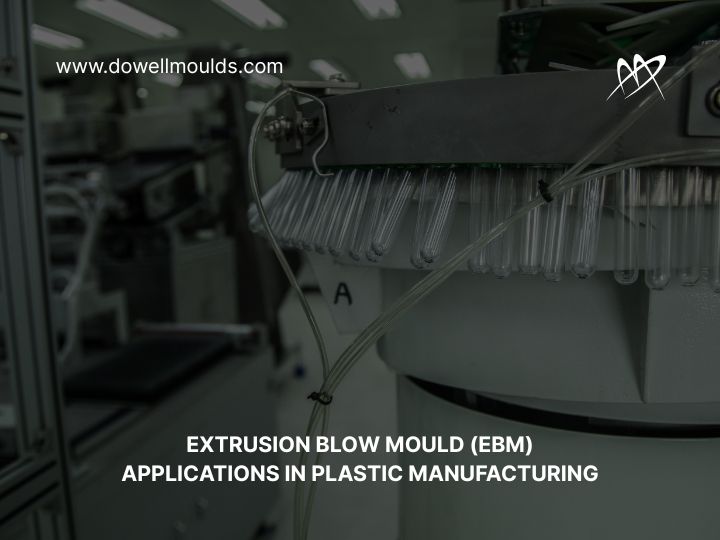
Extrusion Blow Moulding (EBM) is one of the most widely used plastic manufacturing processes for producing hollow plastic parts. From everyday bottles to industrial containers, EBM enables efficient, cost-effective, and precise production. Let’s take a closer look at how EBM works and its major applications.
What is Extrusion Blow Moulding?
EBM is a process in which molten plastic is extruded into a hollow tube, called a parison, and then clamped inside a mould. Compressed air is injected to expand the parison, taking the shape of the mould cavity. Once cooled, the final hollow product is ejected.
How the Extrusion Blow Moulding Process Works
Plastic Extrusion
- Plastic pellets are melted and extruded into a tube-shaped parison.
Mould Clamping & Inflation
- The parison is enclosed within a mould.
- Compressed air inflates it, forming the desired hollow shape.
Cooling & Ejection
- The mould is cooled to solidify the plastic.
- The finished product is removed for trimming and finishing.
Advantages of EBM
- Versatility – Can produce complex, hollow shapes with uniform wall thickness.
- Cost-Effective – Efficient for high-volume production of plastic containers.
- Material Flexibility – Works with a wide range of thermoplastics like HDPE, LDPE, and PET.
- Durability – Produces strong, lightweight, and consistent products.
Applications of Extrusion Blow Moulding
- Bottles & Containers – Water, soft drinks, milk, oils, and household chemicals.
- Industrial Products – Fuel tanks, drums, and large storage containers.
- Medical Packaging – Syringes, laboratory bottles, and pharmaceutical containers.
- Consumer Goods – Toys, cosmetic containers, and packaging solutions.
EBM vs. Injection Blow Moulding
While EBM is ideal for large hollow parts and high-volume production, injection blow moulding (IBM) is preferred for small, precise, and complex containers. Choosing the right method depends on product size, design, and production requirements.
Conclusion
Extrusion Blow Moulding is a flexible and cost-efficient manufacturing process that serves multiple industries, from beverages and pharmaceuticals to automotive and consumer goods. Its ability to produce durable, hollow plastic products makes it indispensable in modern plastic manufacturing.