
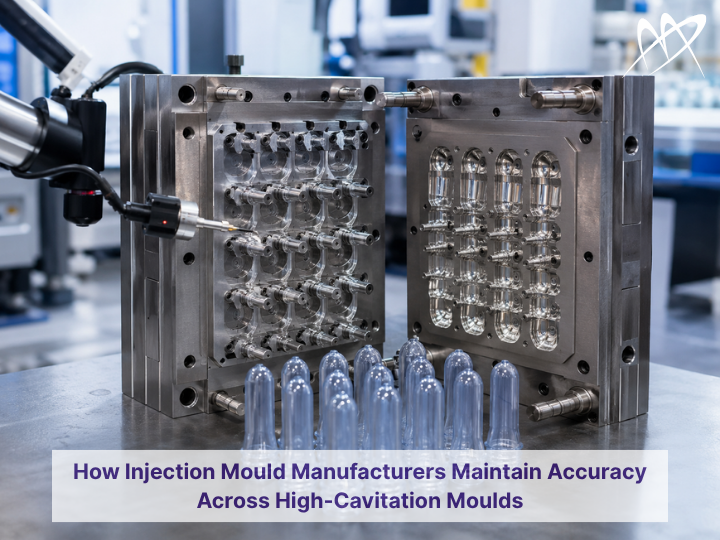
Manufacturers in industries such as automotive, medical devices, FMCG, consumer goods, electronics, and packaging depend on high-volume plastic component production without compromising quality. One of the most effective ways to achieve this is by using High-Cavitation Mould Manufacturers, which produce multiple identical components in a single injection moulding cycle. However, increasing the number of cavities also increases the challenge of maintaining consistent dimensions, surface finish, and product quality across every cavity.
This is where experienced Injection Mould Manufacturers make a significant difference. Through precision engineering, advanced CNC and EDM machining, Mold Flow Analysis, and rigorous quality inspection, they ensure that every cavity performs consistently throughout the mould's production life. Even the smallest variation in machining accuracy or cooling efficiency can affect product quality and increase production costs.
Key Takeaways
-
High-cavitation moulds improve production efficiency by manufacturing multiple parts in one cycle.
-
Consistent accuracy across all cavities is essential for maintaining product quality.
-
Precision engineering, advanced machining, and Mold Flow Analysis help reduce dimensional variation.
-
Quality inspection and process validation ensure long-term mould reliability.
-
Choosing an experienced Injection Mould Manufacturer India improves production consistency and reduces operational costs.
Why Accuracy Is Critical in High-Cavitation Moulds
Unlike single-cavity moulds, High-Cavitation Mould Manufacturers must produce several identical components simultaneously. Every cavity should fill, cool, and eject the plastic part in exactly the same way. If even one cavity performs differently, manufacturers may experience inconsistent part dimensions, higher rejection rates, increased material waste, and frequent production interruptions.
For industries that manufacture thousands or even millions of plastic components, maintaining cavity-to-cavity consistency is essential for meeting quality standards and controlling manufacturing costs.
Leading Injection Mould Manufacturers achieve this through precise design, optimized material flow, balanced cooling systems, and strict quality control at every stage of the manufacturing process.
How Injection Mould Manufacturers Maintain Accuracy
1. Precision Product Design and Engineering
Every successful Precision Injection Mould begins with a detailed engineering process. Before manufacturing starts, engineers analyze product geometry, material selection, wall thickness, production volume, and machine compatibility.
Using advanced CAD software, they develop a complete 3D mould design that ensures every cavity is positioned accurately and functions uniformly.
This design stage helps:
-
Reduce engineering errors
-
Improve cavity balance
-
Optimize cooling channel placement
-
Enhance mould durability
-
Simplify future maintenance
A well-designed mould creates the foundation for consistent production performance.
2. Mold Flow Analysis Before Manufacturing
Before machining begins, manufacturers use Mold Flow Analysis to simulate how molten plastic flows through the runner system and into each cavity.
The simulation helps engineers evaluate:
-
Flow balance
-
Filling pressure
-
Gate location
-
Cooling efficiency
-
Weld lines
-
Air traps
-
Shrinkage
-
Warpage
By identifying potential issues early, engineers can optimize the mould design before steel cutting starts, reducing costly modifications later and improving production efficiency.
3. High-Precision CNC and EDM Machining
Maintaining identical cavity dimensions requires exceptional machining accuracy.
Modern Injection Mould Manufacturers rely on advanced CNC machining centres and EDM technology to manufacture every mould component within extremely tight tolerances.
These technologies provide:
-
Micron-level dimensional accuracy
-
Excellent repeatability
-
Consistent cavity geometry
-
Superior surface finish
-
Reduced machining variation
For High-Precision Plastic Mould Manufacturers, precision machining ensures every cavity produces identical components, even during continuous high-volume production.
4. Premium Tool Steel Selection
The quality of a Plastic Injection Mould also depends on the material used during manufacturing.
Experienced manufacturers carefully select premium-grade tool steels based on production volume, plastic resin, wear resistance, and expected mould life.
High-quality tool steel provides:
-
Better wear resistance
-
Improved dimensional stability
-
Enhanced corrosion resistance
-
Longer operational life
-
Consistent machining accuracy
Using the right steel helps maintain cavity accuracy over millions of production cycles while reducing maintenance requirements.
5. Balanced Cooling System Design
Cooling is one of the most important factors influencing mould accuracy. Uneven cooling can cause shrinkage differences, warpage, and dimensional variation between cavities.
To achieve uniform cooling, engineers carefully design cooling channels that distribute temperature evenly throughout the mould.
An optimized cooling system helps:
-
Reduce cycle time
-
Improve dimensional consistency
-
Minimize internal stress
-
Increase production efficiency
-
Extend mould life
Balanced cooling is especially important in Multi-Cavity Injection Mould applications, where every cavity must cool at the same rate to produce identical plastic components.
6. Precision Quality Inspection and Validation
Manufacturing a high-cavitation mould is only part of the process. The next critical step is verifying that every cavity meets the required engineering standards before the mould enters production.
Leading Injection Mould Manufacturers use advanced inspection equipment to measure critical dimensions, cavity alignment, surface finish, and component fit. By checking these parameters throughout manufacturing, potential deviations can be identified and corrected early.
Quality inspection typically focuses on:
-
Cavity and core dimensions
-
Surface finish quality
-
Cavity-to-cavity consistency
-
Alignment of moving components
-
Cooling channel accuracy
-
Tolerance verification
This systematic approach helps ensure that every cavity produces identical plastic parts, reducing rejection rates and improving long-term production reliability.
7. Trial Mould Testing Before Production
Before delivery, every Precision Injection Mould undergoes trial runs under actual production conditions. This stage confirms that the mould performs as expected and is ready for high-volume manufacturing.
During testing, engineers evaluate:
-
Dimensional consistency across all cavities
-
Filling balance
-
Cooling performance
-
Product surface finish
-
Flash formation
-
Cycle time
-
Ejection performance
If required, minor adjustments are made to optimise mould performance before final approval. This process reduces commissioning time at the customer's facility and ensures a smoother production start-up.
Common Challenges in High-Cavitation Mould Manufacturing
Producing High-Cavitation Moulds requires overcoming several engineering challenges that directly influence part quality and production efficiency.
Some of the most common challenges include:
Maintaining Cavity-to-Cavity Consistency
Every cavity must produce components with identical dimensions. Even slight machining or cooling variations can lead to inconsistent product quality.
Achieving Uniform Material Flow
Balanced runner systems and correctly positioned gates ensure molten plastic reaches every cavity evenly, reducing defects and maintaining dimensional accuracy.
Controlling Heat Distribution
Uneven cooling may result in shrinkage, warpage, or longer cycle times. Optimised cooling channels help maintain stable production across all cavities.
Extending Mould Life
Continuous production places significant stress on mould components. Premium tool steel, proper heat treatment, and preventive maintenance help extend operational life and minimise downtime.
Addressing these challenges early allows manufacturers to achieve reliable performance over millions of production cycles.
Latest Innovations in High-Cavitation Mould Manufacturing
The demand for faster production and tighter quality standards has encouraged Injection Mould Manufacturers to adopt advanced manufacturing technologies that improve accuracy and productivity.
Some of the latest developments include:
-
AI-assisted mould design for faster engineering optimisation
-
High-speed CNC machining for tighter tolerances
-
Automated quality inspection systems
-
Conformal cooling designs for improved heat transfer
-
Digital production monitoring for process consistency
-
Advanced hot runner systems for balanced material flow
-
Sustainable mould designs that reduce material waste and energy consumption
These innovations help manufacturers produce High-Precision Plastic Moulds that deliver consistent quality while supporting efficient, high-volume production.
How to Choose the Right Injection Mould Manufacturer
Selecting the right manufacturing partner is essential for achieving reliable production performance and long-term value.
When evaluating an Injection Mould Manufacturer India, consider the following:
-
Experience in designing multi-cavity moulds
-
Expertise in precision engineering and mould development
-
Advanced CNC, EDM, and CAD/CAM capabilities
-
Use of Mold Flow Analysis during design
-
Strong quality inspection and testing procedures
-
Proven ability to deliver customised mould solutions
-
Reliable technical support and after-sales service
Working with an experienced manufacturer helps reduce production risks and ensures consistent product quality throughout the mould's service life.
Why Choose Dowell Moulds Pvt. Ltd.?
Dowell Moulds Pvt. Ltd. delivers precision-engineered mould solutions for industries that demand accuracy, durability, and production efficiency. With modern manufacturing infrastructure and experienced engineering teams, the company develops moulds designed for reliable long-term performance.
Dowell Moulds offers:
-
Custom Plastic Injection Mould design and manufacturing
-
Expertise in High-Cavitation Moulds and Multi-Cavity Injection Mould solutions
-
Advanced CNC and EDM machining
-
Mold Flow Analysis for optimised mould performance
-
Comprehensive quality inspection and validation
-
End-to-end engineering support from concept to production
By combining technical expertise with advanced manufacturing processes, Dowell Moulds helps customers improve productivity, reduce downtime, and achieve consistent mould performance.
Conclusion
Maintaining accuracy across High-Cavitation Moulds requires more than advanced machinery it demands precision engineering, detailed process planning, and strict quality control. From product design and Mold Flow Analysis to precision machining, balanced cooling, inspection, and production trials, every stage contributes to delivering moulds capable of producing identical components with exceptional consistency.
Choosing experienced Injection Mould Manufacturers ensures access to advanced manufacturing capabilities, technical expertise, and dependable support. Whether your project involves automotive, packaging, medical, or consumer goods applications, investing in a high-quality mould helps improve efficiency, reduce production costs, and achieve reliable long-term manufacturing performance.