
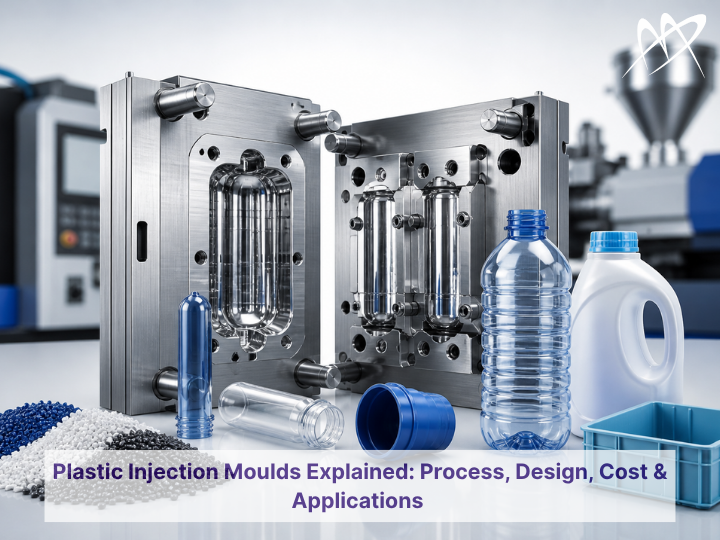
Plastic injection moulds are precision-engineered tools used to manufacture plastic components by injecting molten material into a mould cavity. They are widely used for high-volume production due to their accuracy, consistency, and cost efficiency.
In modern manufacturing, plastic injection moulds play a critical role in producing everything from automotive parts to packaging and consumer goods. At Dowell Moulds, expertise is focused on three core technologies: Injection Mould, Compression Mould, and Blow Mould each designed for specific production needs and applications.
What Are Plastic Injection Moulds?
Plastic injection moulds are industrial tools used in the injection moulding process to shape molten plastic into precise components. The mould consists of a core and cavity, where the material is injected, cooled, and solidified into the final product.
Key Benefits of Plastic Injection Moulds
-
High precision and repeatability
-
Suitable for complex designs
-
Fast production cycles
-
Low per-unit cost in mass production
-
Minimal material waste
Because of these advantages, plastic injection moulds are widely used across multiple industries.
Types of Plastic Moulds
Different manufacturing requirements demand different moulding technologies. The three main types are:
-
Injection Mould
-
Compression Mould
-
Blow Mould
Each type is selected based on product complexity, material, and production volume.
Injection Mould: Process, Design and Applications
Injection Moulding Process
The injection moulding process follows a structured cycle:
-
Clamping – The mould is securely closed
-
Injection – Molten plastic is injected into the cavity
-
Cooling – The material solidifies into shape
-
Ejection – The finished product is removed
This process ensures consistent quality and high-speed production.
Features of Injection Mould
-
Excellent dimensional accuracy
-
Ideal for complex geometries
-
Supports a wide range of thermoplastics
-
Highly scalable for mass production
Applications of Plastic Injection Moulds
-
Automotive components
-
Electrical and electronic housings
-
Packaging products
-
Consumer goods
Plastic injection moulds are the preferred choice when precision and volume are critical.
Compression Mould: Process, Features and Uses
Compression Moulding Process
Compression moulding involves:
-
Placing material into a heated mould
-
Applying pressure to shape the material
-
Cooling and curing the product
-
Removing the finished component
Features of Compression Mould
-
Lower material waste
-
Suitable for thermosetting plastics
-
Cost-effective for medium production
-
Strong and durable products
Applications
-
Automotive structural parts
-
Electrical insulation components
-
Industrial equipment
Compression moulds are ideal for applications where strength and durability are essential.
Blow Mould: Process, Features and Applications
Blow Moulding Process
The blow moulding process includes:
-
Creating a preform
-
Expanding it using compressed air inside the mould
-
Forming the shape against mould walls
-
Cooling and ejecting the product
Features of Blow Mould
-
Perfect for hollow products
-
Lightweight and uniform thickness
-
High production efficiency
-
Suitable for large-scale manufacturing
Applications
-
Bottles and containers
-
Pharmaceutical packaging
-
Cosmetic packaging
-
Beverage industry
Blow moulds are widely used for producing packaging products efficiently.
Plastic Mould Design: Key Factors for Quality
A well-optimized plastic mould design directly impacts production efficiency and product quality. Important design considerations include:
-
Material selection (steel or aluminum)
-
Cooling system design for faster cycles
-
Uniform wall thickness to prevent defects
-
Proper gate and runner system
-
Draft angles for easy ejection
Effective plastic mould design reduces defects, improves productivity, and increases mould life.
Cost of Plastic Injection Moulds
The cost of plastic injection moulds depends on several factors:
-
Mould complexity and size
-
Number of cavities
-
Type of mould (Injection, Compression, Blow)
-
Material used for mould manufacturing
-
Production volume
Cost Insight
-
Injection moulds: Higher initial cost, lower cost per unit
-
Compression moulds: Moderate cost, durable output
-
Blow moulds: Cost-effective for hollow products
Understanding these factors helps businesses plan better and optimize manufacturing investment.
What Are Plastic Injection Moulds Used For?
Plastic injection moulds are used for:
-
Mass production of plastic components
-
Manufacturing complex and detailed parts
-
Reducing production cost at scale
-
Ensuring consistent product quality
They are essential in industries that require precision and efficiency.
How to Choose the Right Plastic Mould
Choosing the right mould depends on:
-
Product design complexity
-
Required production volume
-
Material type
-
Cost and budget
-
End-use application
Quick Selection Guide
-
Injection mould – Best for precision and high volume
-
Compression mould – Best for strength and durability
-
Blow mould – Best for hollow products
Selecting the right mould ensures better performance and cost efficiency.
Benefits of Plastic Injection Moulding
The plastic injection moulding process offers several advantages:
-
High production efficiency
-
Consistent product quality
-
Reduced material waste
-
Ability to produce complex designs
-
Cost-effective for large-scale manufacturing
These benefits make plastic injection moulds a preferred solution across industries.
Conclusion
Plastic injection moulds are a fundamental part of modern manufacturing, offering precision, scalability, and cost efficiency. Along with compression moulds and blow moulds, they provide versatile solutions for a wide range of industrial applications.
By understanding the injection moulding process, mould design principles, and cost factors, businesses can choose the right manufacturing approach and achieve consistent, high-quality production results.
Get in Touch with Dowell Moulds
-
Request a Free Quote: Ensure your caps are leak-proof, durable, and high-quality.
-
Call Us Directly: +91 9825107634 / +91 7874123000
-
Email Us: info@dowellmoulds.com
-
Visit Our Website: www.dowellmoulds.com for more information
-
Expert Consultation: Get guidance on custom compression closure moulds tailored to your product needs.