
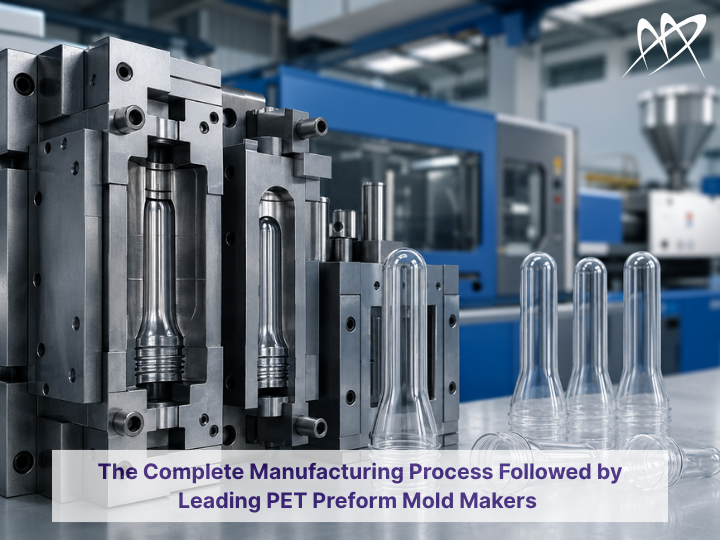
From bottled water and carbonated beverages to pharmaceutical syrups, edible oils, cosmetics, and household products, PET bottles are widely used across modern packaging. While consumers see the finished bottle, its quality begins much earlier with the precision of the mould used to manufacture the PET preform.
A well-engineered PET preform mould helps manufacturers achieve consistent preform dimensions, stable cycle times, efficient cooling, reduced material waste, and reliable performance during high-volume production.
Leading PET Preform Mould Manufacturers follow a systematic process that combines product engineering, CAD/CAM design, Mold Flow Analysis, precision CNC and EDM machining, assembly, dimensional inspection, and production trials. Each stage plays an important role in determining the accuracy, durability, and productivity of the finished tooling.
Key Takeaways
-
Precision engineering is the foundation of a reliable PET preform mould.
-
CAD/CAM and Mold Flow Analysis help validate the design before machining.
-
CNC and EDM machining provide accurate cavity and core geometry.
-
Cooling and hot runner systems influence cycle time and preform consistency.
-
CMM inspection and trial production help validate mould performance.
-
Multi-cavity tooling requires careful attention to flow, cooling, and cavity-to-cavity consistency.
-
Choosing an experienced mould manufacturer can support reliable long-term production.
What Is a PET Preform Mould?
A PET preform mould is a precision injection mould used to manufacture PET preforms, which are later reheated and stretch blow moulded into finished PET bottles. The tooling controls important characteristics such as preform dimensions, neck finish, weight, wall distribution, cooling, and cavity-to-cavity consistency.
For high-volume production, the mould must maintain accurate dimensions and stable performance across a large number of production cycles. Depending on the application, its design may include precision-machined cavities and cores, a hot runner system, cooling channels, inserts, and an efficient ejection arrangement.
The number of cavities is selected according to production requirements, preform specifications, and injection moulding machine capabilities. In multi-cavity tooling, maintaining consistent filling and cooling across all cavities is particularly important because variations can affect preform weight and dimensions.
For this reason, manufacturers must control every stage of the tooling process, from initial engineering and simulation through machining, assembly, inspection, and final trial production.
Complete Manufacturing Process of a PET Preform Mould
1. Product Requirements and Engineering Design
The manufacturing process begins with a detailed understanding of the customer's production requirements.
Engineers review specifications such as:
-
Preform weight and dimensions
-
Bottle capacity
-
Neck finish
-
Required cavity count
-
PET resin requirements
-
Production volume
-
Injection moulding machine specifications
-
Expected cycle time
-
Cooling requirements
Using CAD software, engineers develop a detailed three-dimensional model of the tooling. The design covers cavity and core geometry, hot runner configuration, cooling channels, ejection mechanisms, mould components, and other critical features.
For multi-cavity applications, cavity layout and balancing are particularly important. The design must support consistent material distribution and cooling so that every cavity produces preforms within the required specifications.
Early design validation helps identify potential problems before machining begins. This can reduce rework, modifications, production delays, and unnecessary tooling costs.
2. Mold Flow Analysis and Design Validation
Before machining begins, engineers can use Mold Flow Analysis to simulate how molten PET moves through the hot runner and into the individual cavities.
The analysis can help evaluate:
-
Filling behaviour
-
Flow balance between cavities
-
Gate location
-
Pressure distribution
-
Cooling behaviour
-
Air traps
-
Shrinkage
-
Potential warpage
-
Filling and packing conditions
Flow balance becomes particularly important as cavity count increases. If material does not reach each cavity consistently, the resulting preforms can vary in weight, dimensions, or quality.
Digital simulation allows engineers to identify potential issues during the design stage rather than after the physical mould has been manufactured. Design changes made at this stage are generally easier and more efficient than modifications during production trials.
3. Precision CNC and EDM Machining
After design approval, individual mould components are manufactured using precision machining technologies.
CNC machining is used to produce critical mould components according to specified engineering dimensions and tolerances. EDM machining can be used for intricate geometries and features that may be difficult or unsuitable to produce using conventional cutting methods.
Precision machining supports:
-
Accurate cavity and core dimensions
-
Consistent cavity-to-cavity geometry
-
Tight dimensional tolerances
-
Repeatable component manufacturing
-
High-quality surface finishes
Machining accuracy is particularly important in multi-cavity PET preform tooling. Small dimensional differences between cavities can influence the consistency of the finished preforms.
The machining stage therefore requires controlled processes, appropriate tooling, accurate measurement, and careful inspection.
4. Cooling System and Hot Runner Integration
Cooling and material distribution systems have a direct influence on mould performance, preform quality, and production cycle time.
Engineers design cooling channels around critical mould areas to remove heat efficiently and maintain stable thermal conditions. Consistent cooling helps support dimensional stability and repeatable production.
The hot runner system is also designed to distribute molten PET to the individual cavities. Its configuration depends on factors such as cavity arrangement, preform design, gate requirements, material characteristics, and production conditions.
An appropriately designed cooling and hot runner system can contribute to:
-
Stable material distribution
-
Consistent cavity filling
-
Efficient heat removal
-
Shorter production cycles
-
Improved preform consistency
-
Reduced material waste
Both systems must be considered during the initial engineering stage rather than treated as separate components after mould construction.
5. Heat Treatment, Surface Finishing and Assembly
Selected mould components may undergo heat treatment to achieve the required hardness, wear resistance, and dimensional stability.
After machining and treatment, critical surfaces are finished and polished according to the requirements of the application. Proper surface finishing can support smooth material release and help achieve the required appearance of the preform.
The individual components are then assembled carefully.
Engineers verify the alignment and fit of:
-
Cavities
-
Cores
-
Inserts
-
Cooling components
-
Hot runner components
-
Moving mechanisms
-
Ejection components
Accurate assembly is essential because even correctly machined components can create production problems if they are improperly aligned or fitted.
6. Dimensional Inspection and Quality Control
Before the mould enters trial production, critical components undergo dimensional inspection.
Depending on the required tolerances and component geometry, manufacturers may use Coordinate Measuring Machines (CMM), precision gauges, microscopes, and other inspection equipment.
Quality checks may cover:
-
Cavity and core dimensions
-
Neck finish geometry
-
Component alignment
-
Surface finish
-
Cooling-channel integrity
-
Critical tolerances
-
Cavity-to-cavity consistency
CMM inspection can help compare manufactured components against the approved engineering design and identify dimensional deviations before trial production.
Quality control should not be limited to the final inspection. Checking critical dimensions throughout manufacturing helps identify problems earlier and reduces the possibility of major corrections later.
7. Trial Production and Performance Validation
After assembly and inspection, the completed mould undergoes trial production under appropriate processing conditions.
Engineers evaluate the resulting preforms for:
-
Preform dimensions
-
Weight consistency
-
Neck finish accuracy
-
Surface appearance
-
Cooling performance
-
Ejection behaviour
-
Cycle time
-
Cavity-to-cavity consistency
For multi-cavity tooling, individual cavities are evaluated to identify potential differences in output.
If adjustments are required, engineers may modify relevant mould components or optimise processing parameters before conducting additional trials.
The purpose of trial production is to verify that the completed tooling can deliver the required production performance before final approval and commissioning.
Factors That Influence PET Preform Mould Quality
Several engineering and manufacturing factors determine the performance, durability, and consistency of PET preform tooling.
Tool Steel Selection
The selected mould material should provide suitable hardness, wear resistance, dimensional stability, and corrosion resistance for the intended production environment.
Material selection should also take expected production volume, operating conditions, maintenance requirements, and tooling life into account.
Cavity and Core Accuracy
Accurate cavity and core machining is essential for maintaining consistent preform dimensions.
In multi-cavity moulds, cavity-to-cavity consistency is particularly important because dimensional variation can result in differences in preform weight and geometry.
Cooling System Design
Cooling has a major influence on cycle time and dimensional stability.
A properly engineered cooling system removes heat consistently from critical areas and helps maintain repeatable production conditions.
Hot Runner and Gate Design
The hot runner and gate system must distribute PET consistently to the individual cavities.
Poor material distribution can contribute to filling variation, inconsistent preform characteristics, and production instability.
Surface Finish
The surface condition of cavities and cores can influence preform appearance, material release, and maintenance requirements.
Appropriate finishing and polishing are therefore important during the final preparation of the mould.
Dimensional Inspection
Inspection using CMMs and precision measuring equipment helps verify that critical components meet approved engineering specifications.
Regular inspection also allows manufacturers to identify deviations before they affect trial or production performance.
Maintenance and Operating Conditions
Even precision-engineered tooling requires proper maintenance.
Cleaning, inspection, appropriate lubrication where applicable, replacement of wear components, and suitable operating conditions can help maintain mould performance over its service life.
Latest Innovations in PET Preform Mould Manufacturing
PET packaging manufacturers increasingly require tooling that delivers higher output, shorter cycles, consistent quality, and efficient material use. These requirements are driving continued development in mould design and manufacturing technology.
High-Cavity Mould Technology
High-cavity tooling allows manufacturers to produce more preforms during each injection cycle.
However, increasing cavity count also makes flow balancing, cooling uniformity, dimensional control, maintenance, and quality inspection more demanding.
Advanced Hot Runner Systems
Modern hot runner systems are designed to provide consistent material distribution to individual cavities.
Appropriate runner and gate design can improve filling consistency while reducing unnecessary material waste.
Optimized Cooling Technology
Advanced cooling-channel layouts can improve heat removal and contribute to shorter cycle times.
Consistent thermal management also supports repeatable preform dimensions and production quality.
Digital Design and Simulation
CAD/CAM systems and Mold Flow Analysis allow engineers to evaluate mould geometry and material flow before physical manufacturing.
Digital validation can help identify design problems earlier and reduce the number of modifications required during physical trials.
Precision Digital Inspection
Modern CMM and measurement systems enable manufacturers to verify critical mould dimensions accurately.
Digital inspection can also help compare manufactured components against their original CAD specifications, supporting more consistent quality control.
PET Moulds for Recycled PET
The increasing use of recycled PET (rPET) is creating new considerations for packaging production.
Variations in recycled material properties can affect processing behaviour, making appropriate tooling design and process control important when manufacturing preforms using rPET.
How to Choose the Right PET Preform Mould Manufacturer
The right manufacturing partner should combine precision engineering, advanced machining, quality inspection, trial testing, and technical support.
When evaluating potential suppliers, consider:
-
Experience with PET preform tooling
-
CAD/CAM design capabilities
-
CNC and EDM machining facilities
-
Mold Flow Analysis expertise
-
Multi-cavity mould manufacturing experience
-
Cooling and hot runner design capabilities
-
Dimensional inspection systems
-
Trial production and validation procedures
-
Engineering support
-
After-sales and maintenance support
-
Experience with domestic and export projects
Price should not be the only consideration. Tooling quality, production reliability, maintenance requirements, technical support, and expected service life can have a much greater effect on the overall cost of production.
Why Choose Dowell Moulds Pvt. Ltd.?
Dowell Moulds Pvt. Ltd. specializes in precision mould manufacturing for plastic packaging applications. The company combines engineering, machining, inspection, assembly, and testing to develop tooling designed around specific production requirements.
For PET preform applications, the tooling process can be focused on critical requirements such as cavity accuracy, dimensional consistency, cooling efficiency, mould durability, and reliable production performance.
Dowell Moulds offers:
-
Custom PET Preform Injection Mould solutions
-
CAD/CAM-based mould engineering
-
CNC and EDM machining
-
Mold Flow Analysis and design validation
-
Multi-cavity mould solutions
-
Dimensional inspection and quality control
-
Mould assembly and trial testing
-
Engineering support throughout the project
Manufacturers evaluating a tooling supplier should assess the supplier's actual machining capabilities, inspection systems, technical expertise, project experience, and ability to meet the required PET preform specifications.
PET Preform Mould Manufacturing Checklist
Before approving tooling for production, manufacturers should evaluate:
-
Preform weight and dimensions
-
Neck finish specifications
-
Required cavity configuration
-
Injection moulding machine compatibility
-
PET resin and processing requirements
-
Cavity and core accuracy
-
Hot runner and gate design
-
Cooling-channel configuration
-
Expected cycle time
-
Tool steel and component materials
-
Surface finish requirements
-
Cavity-to-cavity consistency
-
Dimensional inspection procedures
-
Trial production results
-
Maintenance requirements
-
Technical support
A complete evaluation helps manufacturers select tooling that is suitable not only for initial production but also for reliable long-term operation.
Conclusion
The quality of a PET bottle begins with the precision of the preform from which it is produced. Manufacturing a reliable PET preform mould therefore requires much more than machining individual components.
From product engineering and Mold Flow Analysis to CNC and EDM machining, cooling and hot runner integration, assembly, dimensional inspection, and trial production, every stage contributes to tooling accuracy and production performance.
Working with an experienced PET preform tooling manufacturer can help packaging companies achieve consistent preform quality, stable production cycles, reduced downtime, and dependable mould performance.
Whether the requirement is for a specialized or multi-cavity PET preform mould, manufacturers should evaluate engineering capability, machining accuracy, quality control, testing procedures, and long-term technical support before selecting a tooling partner.