
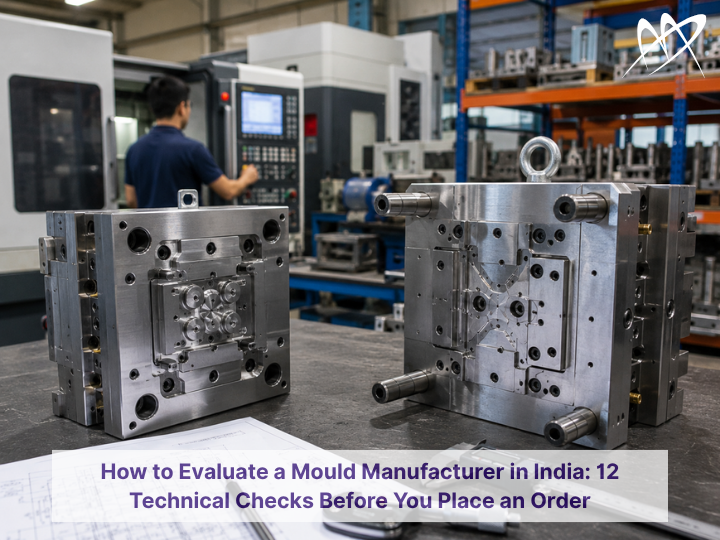
Choosing among mould manufacturers is not simply a matter of comparing quotations. A mould is a production asset that can influence product quality, cycle time, material consumption, maintenance frequency, and manufacturing continuity for years.
For OEMs, packaging companies, product designers, procurement managers, and production engineers, the right supplier should therefore be evaluated on engineering capability, machining accuracy, materials, validation procedures, and after-sales support not just price.
A Mould Manufacturer in India may offer an attractive quotation, but the more important question is whether the finished tool can consistently meet the required part dimensions, output, cycle time, and service-life expectations.
Here are 12 technical checks to complete before placing your mould order.
1. Check the Manufacturer's Engineering and Design Capability
The first check should be the manufacturer's ability to convert your product concept into a manufacturable mould.
Ask whether the team can review:
-
Part geometry and wall thickness
-
Draft angles and undercuts
-
Parting-line locations
-
Gate positions
-
Ejection strategy
-
Cooling requirements
-
Cavity layout
-
Machine compatibility
-
Expected production volume
A capable Injection mould manufacturer should identify potential manufacturing or moulding problems before steel is cut.
Look for evidence of 3D CAD/CAM design, design reviews, engineering documentation, and revision control rather than accepting only a finished drawing.
2. Verify Experience With Your Mould Type and Application
Not every plastic mould manufacturer is experienced in every tooling application.
The mould technology should match the product and production environment. Depending on the application, you may require:
-
Plastic injection moulds
-
Cap and closure moulds
-
Thin-wall packaging moulds
-
Multi-cavity moulds
Dowell Moulds, for example, lists injection, PET preform, cap, closure, compression, and blow mould solutions across its product portfolio.
Ask a prospective supplier for examples of tooling comparable in cavity count, material, product geometry, and production volume to your project.
3. Examine Tool Steel Selection
Tool steel directly affects wear resistance, corrosion resistance, dimensional stability, polishability, and maintenance requirements.
Do not accept a quotation that simply states "high-quality steel." Ask for the actual material grade and its intended application.
Discuss:
-
Cavity and core steel
-
Pre-hardened versus hardened components
-
Inserts and wear components
-
Heat-treatment requirements
-
Corrosion considerations
-
Expected production volume
The correct material depends on factors such as resin type, production volume, abrasiveness, cavity pressure, cooling conditions, and required surface finish.
A lower initial tooling price can become expensive if softer or unsuitable materials lead to premature wear, frequent repairs, or dimensional drift.
4. Evaluate CNC, EDM and Precision Machining Capability
A mould's design is only as good as the accuracy with which it is manufactured.
Your mould manufacturer should have suitable CNC machining, EDM, wire-cut, grinding, and finishing capabilities for the required level of precision.
Ask:
-
Which operations are performed in-house?
-
What machining equipment is used?
-
How are tight tolerances verified?
-
Is electrode design controlled digitally?
-
How is cavity-to-cavity consistency maintained?
-
Which components are outsourced, if any?
CNC machining and EDM are particularly important for complex cavities, cores, inserts, threads, and fine features. Dowell Moulds states that its manufacturing capabilities include CNC machining centres, CAD/CAM, EDM, wire-cut technology, precision measuring equipment, and tool-room facilities.
5. Ask for Mould Flow Analysis Where It Adds Value
For complex or high-volume injection moulds, simulation can identify design risks before manufacturing begins.
Mould Flow Analysis can be used to evaluate factors such as:
-
Filling behaviour
-
Flow balance
-
Gate location
-
Pressure requirements
-
Weld lines
-
Air traps
-
Cooling behaviour
-
Shrinkage
-
Warpage
Simulation is particularly useful when dealing with multi-cavity tooling, thin walls, complex geometries, or demanding dimensional requirements. Cooling and warpage simulations can also help optimize cooling-channel design and reduce cycle-time and deformation risks.
Ask the manufacturer whether simulation is included in the engineering process or available when the application requires it.
6. Review Cavity Layout, Runner and Hot Runner Design
For multi-cavity tooling, cavity count alone does not determine productivity. Every cavity needs to fill and cool consistently.
Review the proposed:
-
Cavity arrangement
-
Runner balance
-
Gate design
-
Hot runner system
-
Valve or open-gate configuration
-
Temperature control
-
Manifold layout
An improperly balanced system can create cavity-to-cavity variation, increasing rejection and process adjustments.
This becomes especially important in high-cavitation PET preform and cap moulds. Dowell Moulds, for instance, specifies high-cavitation PET preform and cap mould solutions, with configurations designed for high-volume production.
7. Inspect the Cooling System Design
Cooling is one of the most important factors affecting cycle time and part stability.
A strong custom mould manufacturing in India partner should consider cooling-channel placement during the initial design rather than treating cooling as an afterthought.
Check whether the design provides:
-
Balanced cooling
-
Appropriate channel positioning
-
Easy coolant connections
-
Adequate cooling near critical areas
-
Temperature consistency between cavities
-
Accessibility for maintenance
Poor cooling can increase cycle time and contribute to shrinkage, warpage, dimensional variation, and unstable production.
8. Understand the Quality Inspection and Validation Process
Before placing an order, ask how the mould manufacturer proves that the tool meets your specifications.
A robust inspection system should address:
-
Critical dimensions
-
Tolerances
-
Cavity-to-cavity consistency
-
Alignment
-
Surface finish
-
Component fit
-
Cooling circuits
-
Functional movement
-
Ejection
-
Product dimensions
Also ask what documentation will be supplied with the mould.
Dowell Moulds states that its quality process covers design validation, raw-material selection, precision machining, assembly, and final inspection, including dimensional accuracy, surface finish, component fitment, cooling performance, and production readiness.
9. Confirm Trial and Acceptance Criteria Before Production
Do not wait until the mould is complete to discuss acceptance.
Before manufacturing starts, agree on measurable criteria such as:
-
Sample-part dimensions
-
Product weight
-
Appearance
-
Flash limits
-
Cycle-time target
-
Cavity consistency
-
Machine compatibility
-
Gate quality
-
Leak or sealing performance where applicable
A mould trial should be treated as an engineering validation stage, not merely a demonstration that the mould opens and closes.
For high-volume applications, acceptance criteria should be clearly documented so that procurement, engineering, and the supplier all work against the same definition of success.
10. Check Machine Compatibility and Production Conditions
A technically sound mould can still underperform if it is not properly matched to the injection or blow moulding machine.
Confirm:
-
Machine make and model
-
Maximum and minimum mould dimensions
-
Clamping requirements
-
Injection capacity
-
Ejection configuration
-
Water connections
-
Electrical requirements
-
Hot runner controller compatibility
-
Available moulding window
For specialised packaging applications, machine compatibility becomes even more important. Dowell Moulds, for example, provides mould solutions across PET preform, injection, compression, and blow moulding applications.
11. Evaluate Maintenance, Spare Parts and Expected Mould Life
A mould should be evaluated over its complete operating life not only at the time of purchase.
Ask the supplier:
-
Which components are expected to wear?
-
Are spare parts readily available?
-
Can inserts be replaced independently?
-
What maintenance schedule is recommended?
-
How should the mould be cleaned and stored?
-
Which components require periodic inspection?
-
What support is available after commissioning?
Maintenance planning becomes particularly important in high-cavitation tools, where a small failure can interrupt a large production line.
Dowell Moulds also supplies mould spare parts and change parts, supporting ongoing maintenance and replacement requirements.
12. Compare Total Cost of Ownership, Not Just the Quoted Price
The lowest quotation is rarely enough information to select a mould supplier.
Instead, consider the total cost of ownership, including:
Tool cost + maintenance + spare parts + downtime + material waste + cycle-time impact + rejection + modification cost
For example, a slightly more expensive mould may deliver better cooling, longer wear life, easier maintenance, and more consistent cavity performance. Over millions of cycles, those differences can outweigh the initial purchase-price gap.
When comparing mould manufacturers, request a technical-commercial quotation that clearly identifies steel grades, cavity count, hot runner system, cooling design, scope of supply, trials, acceptance criteria, warranty, spare parts, and delivery terms.
What Should You Ask a Mould Manufacturer Before Ordering?
Before issuing a purchase order, ask these practical questions:
-
Have you manufactured a similar mould before?
-
What tool steel and heat treatment will be used?
-
What machining processes are performed in-house?
-
Will Mould Flow Analysis be required?
-
How will cavity balance be verified?
-
What is the proposed cooling strategy?
-
How will critical dimensions be inspected?
-
What are the trial and acceptance criteria?
-
Which spare parts will be supplied?
-
What technical support is available after installation?
A manufacturer that gives clear, technically specific answers is easier to evaluate than one that relies mainly on generic claims.
Common Mistakes Buyers Should Avoid
One of the biggest purchasing mistakes is selecting a supplier primarily on price.
Other common mistakes include:
-
Approving the mould before reviewing the complete design
-
Ignoring resin characteristics
-
Failing to define production volume
-
Choosing excessive cavity count without analyzing machine capacity
-
Not reviewing cooling and runner design
-
Leaving acceptance criteria undefined
-
Ignoring spare-parts availability
-
Comparing only the initial tooling price
-
Assuming all steel grades provide the same performance
-
Treating mould maintenance as the supplier's responsibility after delivery
The best How to choose a mould manufacturer approach is to evaluate engineering, manufacturing, validation, service, and lifetime economics together.
How Mould Manufacturers Improve Production Performance
A precision mould is more than a shaped piece of steel. It forms part of the wider injection moulding process.
Good tooling can support:
-
Stable cycle times
-
Consistent product dimensions
-
Reduced rejection
-
Better material utilization
-
Repeatable production
-
Easier maintenance
-
Higher equipment utilization
Modern simulation, CNC machining, digital inspection, automation, and data-driven manufacturing are increasingly becoming part of advanced tooling workflows. Current industry discussions also emphasize smart manufacturing, automation, precision engineering, and improved monitoring as manufacturers seek greater productivity and repeatability.
Which Industries Depend on Precision Mould Manufacturing?
Precision plastic moulds are used across many industries, including:
-
Food and beverage packaging
-
Pharmaceutical packaging
-
Personal care and cosmetics
-
FMCG
-
Medical products
-
Automotive components
-
Electronics
-
Household products
-
Industrial packaging
-
Consumer products
The tooling requirements vary considerably. A PET preform mould may prioritize high cavitation and precise thermal control, while a medical or engineering component may place greater emphasis on dimensional tolerances, material behaviour, surface finish, and repeatability.
Why Choose Dowell Moulds Pvt. Ltd.?
Dowell Moulds Pvt. Ltd. has been established since 2002 and focuses on precision mould solutions for the plastic packaging industry. Its published product portfolio includes PET preform, PP, injection, compression, cap, closure, and blow mould solutions.
The company states that its manufacturing infrastructure includes CNC machining centres, CAD/CAM, EDM, wire-cut technology, precision measuring equipment, and tool-room facilities. Its injection mould manufacturing process also includes design validation, material selection, machining, assembly, inspection, and production-readiness checks.
For buyers evaluating a Mould Manufacturer in India, this type of end-to-end capability is important because mould performance depends on the connection between design, machining, assembly, testing, and technical support.
Final Takeaway
Selecting among mould manufacturers should be a technical evaluation, not simply a quotation exercise.
Before placing an order, verify the supplier's design expertise, mould-type experience, tool-steel selection, CNC and EDM capability, simulation approach, cavity and runner design, cooling system, inspection process, trial procedure, machine compatibility, maintenance support, and total cost of ownership.
The right Industrial mould manufacturing company should be able to explain not only what it will manufacture, but also why the proposed design will perform reliably in your production environment.
For companies developing PET preforms, caps, closures, packaging components, or other precision plastic products, Dowell Moulds Pvt. Ltd. provides injection, compression, blow, PET preform, cap, and related mould solutions. Explore the relevant moulding solutions or contact the Dowell Moulds team to discuss your technical requirements.