
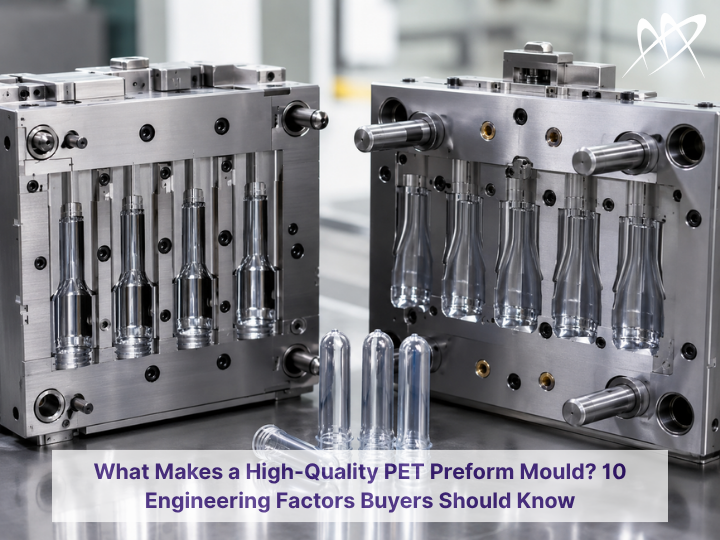
A cracked cavity insert three months into a production run. A preform wall that's off by a fraction of a millimeter, rejected downstream at the blow-moulding stage. A cooling channel that looked fine on the drawing but never actually pulled heat out fast enough to hit cycle-time targets.
None of these problems show up during the sales conversation. They show up on the shop floor, usually after the mould is already running and a production line is depending on it. That's the real reason buyers spend so much time evaluating a PET preform mould before ordering the cost of getting it wrong isn't the mould price, it's the downtime, scrap, and missed deliveries that follow.
What Makes a PET Preform Mould High Quality?
A high-quality PET preform mould consistently produces preforms within dimensional tolerance, cycle after cycle, without excessive maintenance or unplanned downtime. That consistency depends on precise cavity and core machining, balanced cooling, correctly specified steel, and a hot runner system tuned to the resin and preform design being run.
In practice, quality isn't one feature it's the combined result of design accuracy, material selection, and machining precision working together under real production conditions, not just under test-shot conditions.
1. Cavity and Core Precision
The cavity and core define the preform's exact shape, wall thickness, and neck finish. Even small deviations here measured in microns, not millimeters translate into wall thickness variation that shows up later as uneven stretching during blow moulding.
This matters most for high-speed, high-cavitation moulds, where a small design error is replicated across every cavity and every cycle. A 32-cavity mould with a minor cavity mismatch doesn't produce one bad preform it produces one bad preform, 32 times, every shot.
Buyers evaluating this factor should ask for details on the CNC machining process used, the tolerance range the manufacturer works to, and how cavity-to-cavity consistency is verified before the mould ships.
2. Steel Selection and Hardening
PET preform moulds run under high injection pressure, repeated thermal cycling, and constant mechanical wear at the parting line and gate area. The steel grade used and how it's heat-treated determines how long the mould holds its dimensional accuracy before wear starts affecting part quality.
Softer or improperly hardened steel wears faster at high-friction points like the neck ring and gate insert. Over time this shows up as flash, sticking, or gradual dimensional drift that isn't obvious until a batch of preforms starts failing at the blow-moulding stage.
For high-volume operations, steel and hardening specification should be discussed upfront, not assumed. What works for a low-volume, low-cavitation mould may not hold up under continuous, high-cavitation production.
3. Hot Runner System Design
The hot runner system controls how molten PET flows into each cavity and inconsistent flow is one of the most common causes of cavity-to-cavity variation in multi-cavity moulds.
A well-balanced hot runner delivers resin to every cavity at a consistent temperature and pressure, so preforms across all cavities come out with matching weight, wall distribution, and clarity. Poor balancing means some cavities run "hot" and others "cold," producing preforms that pass individually but create inconsistency across a production batch.
This is a factor where mould builders' technical depth matters. Hot runner mould, hot runner cap mould, and hot runner closures mould designs each require different flow balancing approaches depending on part geometry and gate placement.
4. Cooling Channel Layout
PET preform quality particularly clarity and crystallization control depends heavily on how evenly and quickly heat is removed from the cavity. Cooling isn't just about cycle time; uneven cooling produces preforms with inconsistent crystallinity, which later causes uneven stretch ratios and wall thinning during blow moulding.
Conformal or optimized cooling channel layouts, positioned close to the cavity surface without compromising structural integrity, generally support faster and more even heat extraction than generic straight-drilled channels. The right layout depends on preform geometry, wall thickness, and target cycle time, so this is a factor worth discussing at the design stage rather than assuming it's standard across all mould builders.
5. Gate Design and Placement
Gate design affects both fill behavior and the visible gate mark on the finished preform which matters for neck-critical or cosmetically visible applications. Poor gate placement can cause jetting, incomplete fill in thin-walled sections, or weld lines that weaken the preform structurally.
For PET preforms specifically, gate location also affects how evenly material stretches during the blow-moulding stage. A gate positioned incorrectly relative to wall thickness transitions can create thin spots that fail under blow pressure.
6. Venting Design
Trapped air inside the cavity during injection causes short shots, burn marks, or inconsistent surface finish problems that are easy to trace back to venting once they show up, but expensive to fix after a mould is already cut.
Adequate venting at the parting line and around deep-draw areas like the neck and base allows air to escape as PET fills the cavity, without letting resin leak through the vent itself. Getting this balance right requires experience with PET's specific flow characteristics, since it behaves differently than commodity resins like PP or PE.
7. Dimensional Tolerance Control
PET preforms feed directly into blow-moulding equipment that expects consistent input dimensions. A preform that's slightly out of tolerance on wall thickness or neck finish can still "look fine" but cause problems two or three process steps downstream inconsistent bottle wall distribution, weak pinch points, or capping issues.
Buyers should ask how a manufacturer measures and documents tolerance compliance not just at first article inspection, but across a production run, since tolerance drift over time is often more telling than tolerance at day one.
The mould base carries clamping force, injection pressure, and repeated thermal expansion and contraction across thousands or millions of cycles. A mould base that flexes under pressure even slightly can throw off cavity alignment over time, leading to gradual dimensional drift that's hard to diagnose because it develops slowly.
This factor is easy to overlook because it doesn't affect the first few thousand shots. It shows up in month six or month twelve, which is exactly why structural rigidity should be evaluated at the design stage rather than assumed based on mould size or price point.
9. Compatibility with Existing Equipment
A mechanically excellent mould still creates problems if it doesn't match the injection moulding machine's clamping force, shot size, or hot runner controller compatibility. Mismatches here can mean reduced cavitation than originally planned, cycle time compromises, or the need for conversion kits and change parts to bridge the gap.
This is particularly relevant for manufacturers running mixed equipment fleets or planning to move a mould between machines. Confirming compatibility and clarifying what change parts or conversion kits might be needed before finalizing mould specifications avoids costly rework later.
10. After-Sales Support and Spare Parts Availability
Even a well-engineered mould needs maintenance, and inserts, ejector pins, and gate components wear out over time regardless of build quality. What separates a manageable maintenance schedule from unplanned downtime is how quickly spare parts and technical support are available when something needs replacing.
Buyers should factor in spare parts lead time and technical support responsiveness as part of the total cost of ownership not just the upfront mould price. A mould that's cheaper to buy but slower to service can end up costing more in downtime over its working life.
Common Mistakes Buyers Make When Evaluating PET Preform Moulds
-
Focusing only on price per cavity without factoring in cycle time, scrap rate, or maintenance frequency over the mould's working life.
-
Assuming higher cavitation always means better value more cavities amplify any design flaw, so cavitation count should match actual production volume and equipment capability.
-
Not confirming resin and application specifics upfront a mould designed for standard beverage preforms may not perform the same way for wide-mouth jars, edible oil bottles, or pharmaceutical packaging with different clarity or barrier requirements.
-
Overlooking after-sales and spare parts logistics until a part fails and the line is already down.
-
Skipping detailed technical discussion on cooling and hot runner balancing, treating these as standard features rather than design elements that vary by mould builder.
Where This Fits with Dowell Moulds
Dowell Moulds designs and manufactures hot runner PET preform moulds built around the precision and consistency factors covered above from cavity machining and steel selection to cooling layout and hot runner balancing. For businesses running cap, closure, or general injection applications alongside PET preforms, related hot runner mould, hot runner cap mould, get in touch with our engineering teamand hot runner closures mould solutions are engineered under the same design and quality approach.
For operations planning equipment changes or looking to extend an existing mould's working life, conversion kits and spare parts support is available as part of ongoing production planning, not just as an afterthought once something wears out.
Final Takeaway
A high-quality PET preform mould isn't defined by a single feature it's the outcome of precise cavity machining, correctly specified steel, balanced hot runner flow, effective cooling, and structural rigidity all working together under real production conditions. Buyers who evaluate these factors upfront, rather than relying on price or cavitation count alone, are in a better position to avoid the downtime and scrap costs that come from mould-related quality issues later.
For businesses ready to discuss a specific preform design, resin, or production volume, you can get in touch with our engineering team to review mould specifications before finalizing a project.