
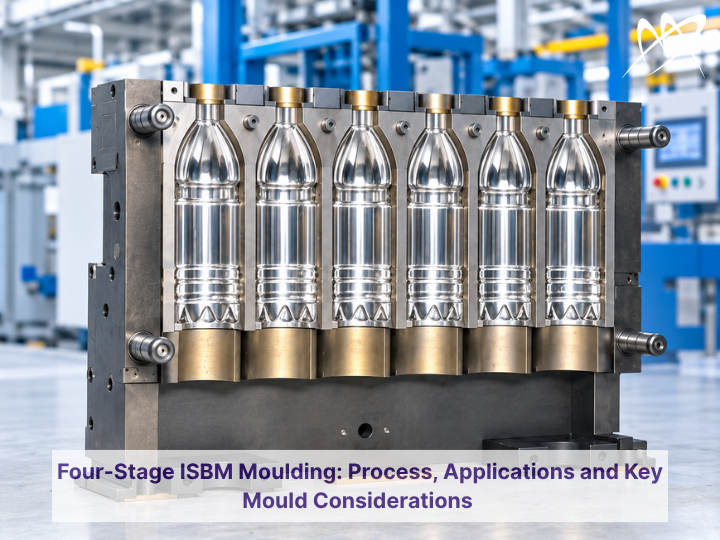
Most explanations of Injection Stretch Blow Moulding (ISBM) stop at the basic distinction between single-stage and two-stage production. In simple terms, single-stage systems combine preform injection and bottle formation within one production system, while two-stage systems produce preforms separately before reheating, stretching, and blowing them into bottles.
Four-stage ISBM processing takes the separation of process functions further by treating preform handling, thermal conditioning, stretch-blow moulding, and bottle ejection as distinct stages. The exact terminology and equipment configuration can vary between machine manufacturers, but the underlying objective is greater control over the preform condition before stretching.
That distinction matters because bottle quality is not determined by the blow mould alone. Wall thickness distribution, clarity, base formation, and structural consistency can all be influenced by how uniformly the preform is conditioned before it enters the mould. For applications with tighter consistency requirements, controlling this thermal and mechanical preparation can be an important part of the overall ISBM process.
What Is Four-Stage ISBM Moulding?
Four-stage ISBM moulding is an approach in which the production sequence is divided into more clearly controlled process stages rather than treating reheating and bottle formation as one compressed operation.
In a typical two-stage ISBM process, PET preforms are produced separately, cooled, stored or transported, and later reheated before being stretched and blown into bottles. The reheating system must establish an appropriate temperature profile through the preform before stretching begins.
A four-stage configuration further emphasizes controlled preform loading and conditioning before the stretch-blow operation. This allows the process to manage the preform's thermal condition more deliberately before it enters the ISBM mould.
The purpose is not simply to add another mechanical step. It is to improve process control so that the preform enters the mould with more consistent conditions, giving the stretching and blowing stages a more predictable starting point.
The Four Stages of ISBM Processing
1. Preform Loading and Orientation
The first stage involves feeding and positioning the preforms for downstream processing. Consistent handling is important because variations in orientation or positioning can affect how individual preforms pass through the heating and stretching system.
Correct loading helps establish repeatable conditions from one preform to the next. This becomes particularly important in high-volume production, where small variations repeated across thousands of cycles can become significant quality issues.
2. Reheating and Temperature Conditioning
The second stage focuses on bringing the preform to the appropriate stretching condition. Rather than simply heating the complete preform uniformly, the process needs to manage temperature distribution across different sections.
The body, neck, and base areas can respond differently to heating because of their geometry and material distribution. If the temperature profile is not properly controlled, different areas of the preform may stretch at different rates during the next stage.
This makes temperature conditioning one of the most important connections between preform production and final bottle quality. The effectiveness of this stage also depends on the starting preform geometry, making PET preform mould design an important consideration when controlling material distribution during later stretching.
3. Stretch-Blow Moulding
Once the preform reaches its required thermal condition, it enters the ISBM mould. A stretch rod mechanically extends the preform axially while compressed air expands it radially against the cavity surface.
The final bottle geometry is therefore produced through a combination of mechanical stretching, material orientation, air pressure, and cavity geometry.
A consistently conditioned preform gives the moulding process a more predictable starting point. However, the mould still needs to be engineered correctly for the intended bottle geometry, stretch ratio, cooling requirements, venting, and dimensional accuracy.
4. Ejection and Final Cooling
After the bottle has formed inside the cavity, it must be sufficiently cooled and stabilized before ejection. Effective heat transfer is important for maintaining the intended bottle dimensions and reducing the risk of deformation after removal from the mould.
Cooling performance becomes especially relevant for lightweighted bottles and complex geometries, where small dimensional changes can have a greater effect on the final product.
How Preform Conditioning Affects PET Bottle Quality
The main benefit of greater conditioning control is that the PET preform can enter the stretch-blow stage with a more predictable temperature profile.
Wall thickness distribution: Temperature differences influence how PET stretches during bottle formation. Better-controlled conditioning can support more consistent material distribution, particularly in lightweighted or complex bottle designs.
Bottle clarity: PET's optical appearance is influenced by thermal history, material behavior, and processing conditions. More uniform conditioning can contribute to consistent appearance, although mould cooling, resin characteristics, and other process parameters also affect final clarity.
Base and shoulder formation: These areas can be sensitive to differences in material temperature and stretching behavior. Controlled conditioning helps establish a more repeatable material response before the preform reaches the cavity.
Structural performance: For pressure-resistant and lightweighted bottles, consistent material distribution is important because localized variation can affect how the finished container responds to internal pressure and mechanical loads.
This is why four-stage processing should not be viewed simply as an additional production step. Its value comes from improving control before the bottle reaches its final shape.
Applications Where Four-Stage ISBM Moulding Can Be Useful
Four-stage processing can be considered where control over material distribution and repeatability is particularly important.
-
Carbonated beverage bottles: These containers need appropriate material distribution and structural performance to withstand internal pressure.
-
Lightweighted PET bottles: Thinner walls provide less tolerance for process variation, making consistent preform conditioning more important.
-
Complex or non-round bottles: More complicated geometries can require careful control of how PET stretches into different areas of the cavity.
-
Pharmaceutical and nutraceutical containers: Consistent dimensions, appearance, and repeatable production conditions can be important depending on the specific packaging application.
However, four-stage processing is not automatically necessary for every PET bottle. A relatively simple bottle geometry with less demanding performance requirements may be adequately produced using a conventional two-stage process.
Key ISBM Mould Design Considerations
Even with improved preform conditioning, the ISBM mould remains a critical part of the production system.
Stretch Ratio Precision
The relationship between preform dimensions and final bottle dimensions directly affects material distribution. The mould design should therefore be coordinated with the specific preform rather than developed independently.
A mismatch between preform geometry and final bottle requirements can result in uneven wall thickness or inconsistent structural performance even when the heating process is well controlled.
Cooling Channel Design
Cooling channels need to provide effective and reasonably uniform heat transfer throughout the mould. Areas such as the base and shoulder may require particular attention depending on the bottle geometry.
For higher-consistency applications, cooling should be considered as part of the complete mould design rather than treated as a secondary feature.
Cavity Machining Accuracy
The cavity must reproduce the approved bottle geometry accurately and consistently. Dimensional variation, surface-finish differences, or machining errors can affect the final bottle even when upstream process conditions are stable.
This is where precision CNC and EDM machining becomes relevant to the wider mould manufacturing process.
Preform-to-Mould Coordination
The preform and bottle mould should be designed around compatible assumptions regarding material volume, stretch behavior, neck dimensions, and final bottle geometry.
Working with a PET preform mould manufacturer that can understand both sides of this relationship can help reduce the risk of treating preform and blow-mould issues as completely separate problems.
Four-Stage vs Single-Stage and Two-Stage ISBM
|
Process |
General Configuration |
Typical Consideration |
|
Single-stage ISBM |
Preform injection and bottle formation within one machine/system |
Compact setup and integrated processing |
|
Two-stage ISBM |
Preforms are produced separately, then reheated and blow moulded |
High-volume production and preform flexibility |
|
Four-stage processing |
Greater separation of handling, conditioning, stretch-blow, and finishing functions |
Additional process control where consistency requirements justify added complexity |
The appropriate approach depends on production volume, bottle geometry, material requirements, equipment availability, quality targets, and process-control capability.
Four-stage processing also introduces additional equipment and control requirements. More sensors, stations, and parameters can increase the importance of disciplined process monitoring. The additional control is useful only when the production team can measure, maintain, and optimize those conditions consistently.
Common Mistakes in Four-Stage ISBM Projects
Several problems can reduce the benefit of a highly controlled ISBM process:
-
Treating the preform and ISBM mould as independent projects instead of coordinating material distribution and stretch requirements.
-
Underestimating conditioning uniformity, assuming the mould can compensate for significant variation in preform temperature.
-
Using a generic cooling layout without considering the specific bottle geometry and production requirements.
-
Ignoring dimensional tolerance coordination between preform and finished bottle specifications.
-
Skipping mould trial and validation, relying on a short trial instead of evaluating sustained production performance.
-
Focusing only on visual appearance, without checking wall thickness, dimensions, bottle weight, and structural performance where applicable.
A controlled trial should therefore evaluate the complete production system rather than only whether the bottle visually matches the intended shape.
What to Check Before Finalizing a Four-Stage ISBM Project
Before approving the mould and process configuration, manufacturers should review the preform geometry, stretch ratio, expected wall thickness distribution, heating requirements, cooling design, venting, cavity accuracy, bottle dimensions, and intended application.
Production volume and equipment capability should also be considered. A process that provides additional control may require more sophisticated monitoring and maintenance practices.
Trial validation is particularly important. Representative production conditions should be used wherever possible so that issues related to temperature distribution, material stretching, cooling, dimensional stability, and sustained cycle performance can be identified before full-scale production.
Four-Stage ISBM Moulding at Dowell Moulds
Dowell Moulds manufactures Injection Stretch Blow Mould solutions for PET bottle applications, including single-stage and two-stage ISBM mould systems. Its ISBM mould range is designed around factors such as precise neck dimensions, material distribution, cavity accuracy, cooling performance, and machine compatibility.
For manufacturers evaluating the engineering factors behind ISBM tooling, the ISBM mould design parameters article provides further information on stretch ratio, cooling, venting, and base design.
Manufacturers can also review Dowell Moulds' manufacturing capabilities to understand its mould design and production capabilities or contact the engineering team to discuss application-specific tooling requirements.
Final Takeaway
Four-stage ISBM moulding provides greater separation and control of preform conditioning before the stretch-blow operation. Its potential value is greatest when bottle consistency, material distribution, lightweighting, or complex geometry leaves less room for process variation.
However, better conditioning does not eliminate the need for precise ISBM mould design. Stretch ratio, cooling, cavity accuracy, preform geometry, and trial validation must work together to achieve repeatable bottle quality.
The most effective approach is therefore to treat preform production, conditioning, mould design, and bottle validation as connected parts of the same manufacturing system rather than as isolated stages.