
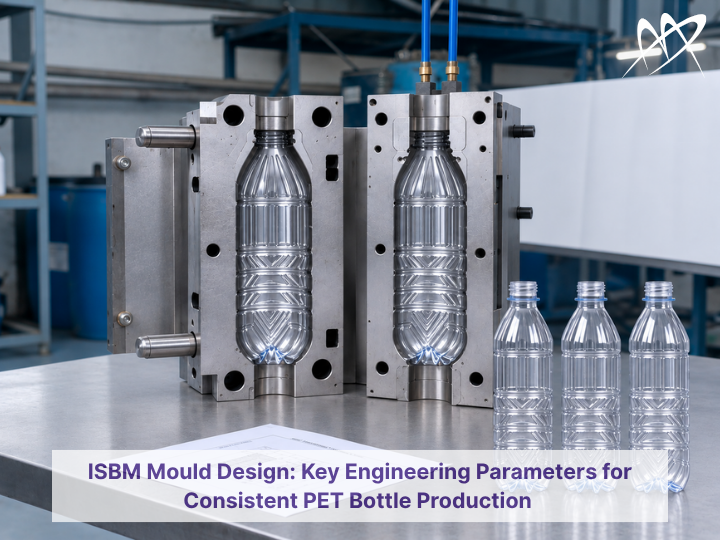
A bottle that looks acceptable off the line doesn't always confirm an ISBM mould is performing correctly. Wall thickness distribution, base clarity, and stress resistance can all drift gradually within a range that still passes casual inspection, until a batch fails a drop test or a customer reports inconsistent fill levels. By the time that happens, the underlying design or process issue has usually been running unnoticed for a while.
Injection Stretch Blow Mould design carries more engineering weight than it's often given credit for. The preform defines the starting material distribution, but the ISBM mould itself determines how that material actually stretches, cools, and solidifies into a finished bottle. Getting these parameters right is what separates consistent PET bottle manufacturing from a process that technically works but produces variable results from shot to shot.
What an ISBM Mould Actually Controls
An ISBM mould shapes the final bottle geometry while the preform, already heated to its stretching temperature, is expanded by a combination of mechanical stretching and compressed air. Unlike extrusion blow moulding, where the parison itself carries most of the material distribution decisions, Injection Stretch Blow Mould design works with a preform whose wall thickness and material distribution were already set during the injection stage.
The ISBM mould's job is to control how that material stretches and orients as it expands into the cavity, and how quickly it cools once it reaches the mould wall. Both of these directly affect the finished bottle's strength, clarity, and dimensional accuracy which is why ISBM mould design deserves the same level of engineering attention as the preform mould itself, rather than being treated as a simpler, secondary tool.
Key Engineering Parameters in ISBM Mould Design
Stretch ratio control - The relationship between preform dimensions and final bottle dimensions determines how much the material stretches axially and radially during blowing. A mould designed without accounting for the preform's actual stretch ratio can produce uneven wall distribution, even when the preform itself was correctly moulded. Getting this relationship right requires close coordination between preform mould design and the ISBM mould, rather than treating them as entirely separate projects.
Cooling channel layout - Bottle cooling in an ISBM mould needs to happen quickly enough to support reasonable cycle times, while remaining even enough to avoid locking in uneven crystallinity or residual stress. Base and shoulder areas, where wall thickness tends to be greatest, generally require more aggressive cooling than thinner sidewall sections to avoid becoming a cycle time bottleneck. The underlying principles here closely mirror those covered in our article on PET preform mould cooling system design, since both stages of PET bottle production depend on controlling crystallization through even, well-balanced heat extraction.
Venting design - As the preform expands against the cavity wall, trapped air needs an escape path, or the bottle surface will show visible pockmarks or incomplete pattern transfer, particularly around label panels or embossed detail. Vent placement and sizing need to balance air escape against the risk of flash forming through vents that are too large.
Pinch-off and base design - The base of the bottle typically experiences the most complex material flow during stretching, since it has to form a stable standing surface while handling significant material thickness variation. Base design that doesn't account for this complexity is a common source of base-related defects, including uneven standing surfaces or stress concentration points that affect drop resistance. Petaloid base designs, common on carbonated beverage bottles, add further complexity, since the base geometry needs to manage both structural stability and internal pressure resistance simultaneously, which places additional demands on both cooling and material flow in that specific region of the mould.
Neck and gate area transition - The area where the preform's unstretched neck meets the stretched body requires careful geometric transition in the mould design to avoid stress concentration at that boundary, which can otherwise become a weak point under pressure or impact.
Cavity surface finish - Surface texture and finish quality directly affect bottle clarity and how cleanly the material releases from the mould after cooling. This matters more for applications where optical clarity is a selling point, such as beverage bottles, than for opaque or heavily labeled containers. Achieving a consistently fine cavity finish depends on the same precision CNC and EDM machining processes used elsewhere in precision mould manufacturing, which is why machining quality carries over directly into how an ISBM mould performs cosmetically.
How Preform Design and ISBM Mould Design Work Together
An ISBM mould should not be designed independently of the preform. The preform's dimensions, wall thickness distribution, material volume, and temperature condition establish the starting point for the stretching process, while the ISBM mould determines how that material is distributed across the final bottle geometry.
This relationship makes stretch ratio an important connection between the two moulding stages. If the preform dimensions do not provide the right amount of material for the intended bottle shape, changes to the ISBM mould alone may not fully resolve wall thickness variation or structural performance issues. For this reason, PET preform mould design and ISBM mould design should be evaluated together during product development and mould trials.
Coordinating both stages also helps manufacturers consider cooling, bottle geometry, material distribution, and production requirements as one system rather than treating each mould as an independent tool.
How These Parameters Affect PET Bottle Manufacturing Consistency
Each of these parameters connects to a specific downstream outcome in PET bottle manufacturing:
Wall thickness consistency depends primarily on stretch ratio control and how evenly the preform's material distribution translates into the final bottle shape. This is also where dimensional tolerance specification matters, since a bottle wall that technically falls within tolerance at one point can still perform inconsistently if tolerance wasn't defined with actual stretch behavior in mind. An ISBM mould manufacturer who treats stretch ratio and tolerance as connected variables, rather than separate checklist items, is generally better positioned to deliver consistent results across a full production run.
Cycle time is largely determined by cooling channel design, since cooling typically represents the largest portion of total blow-moulding cycle time.
Surface quality depends on venting design and cavity finish, both of which affect whether the bottle's final appearance meets cosmetic expectations.
Structural performance, including drop resistance and top-load strength, depends heavily on base design and the neck-to-body transition, since these are the areas most likely to concentrate stress under real-world handling conditions.
What to Consider When Selecting an ISBM Mould Design Approach
Bottle application and performance requirements. A carbonated beverage bottle, which needs to withstand internal pressure, has different structural priorities than a still water or cosmetic bottle, which may prioritize wall thinness and material savings instead.
Production volume and cycle time targets. Higher-volume applications justify more sophisticated cooling system design, since even small cycle time improvements compound significantly across high-volume production runs. A lower-volume or seasonal production program may not justify the added upfront cost of a highly optimized cooling layout, making the right design choice dependent on actual production economics rather than defaulting to the most advanced option available.
Preform and bottle mould coordination. Because stretch ratio depends on the relationship between preform and final bottle geometry, buyers working with a PET bottle mould manufacturer should confirm that preform and ISBM mould design are being coordinated as a single system, not developed independently and matched up later.
Resin and additive considerations. Barrier additives, recycled content, or lightweighting targets can all affect how a given resin formulation stretches and cools, which may require adjustments to standard ISBM mould parameters rather than applying a generic design template. Recycled PET content in particular can behave differently during stretching than virgin resin, which is worth raising directly with a mould designer rather than assuming standard parameters will transfer without adjustment.
What to Check Before Finalizing an ISBM Mould
Before approving an ISBM mould design, manufacturers should review more than the final bottle appearance. The preform-to-bottle stretch ratio, expected wall thickness distribution, cooling requirements, venting, base geometry, cavity finish, production volume, and intended application should all be considered together.
Trial planning is also important. A mould should be evaluated using representative production conditions rather than relying only on a short trial run. Checking wall thickness distribution, bottle weight, dimensional consistency, visual quality, and structural performance can reveal issues that may not be visible during a basic visual inspection.
Working with an ISBM mould manufacturer that can coordinate preform and bottle mould requirements can also reduce the risk of treating problems in one stage as isolated process issues in another.
Common Mistakes in ISBM Mould Design and Specification
Designing the ISBM mould independently of the preform mould, rather than treating stretch ratio as a shared design variable between both tools.
Applying uniform cooling channel design across the entire bottle, without accounting for the different wall thicknesses and cooling demands of the base, shoulder, and sidewall.
Underestimating venting requirements on bottles with detailed surface patterns or label panels, leading to surface defects that only become obvious once the mould is already in production.
Treating base design as a standard template feature, rather than engineering it specifically around the bottle's actual weight distribution and intended use.
Evaluating mould performance only through visual inspection, rather than testing wall thickness distribution and structural performance across a representative sample during mould trial and validation.
Assuming trial results from a short run represent full production performance, when cooling and material behavior can shift once a mould reaches sustained, high-speed operation.
Where This Fits with Dowell Moulds
Dowell Moulds manufactures Injection Stretch Blow Mould systems for both single-stage and two-stage PET bottle production, designed with stretch ratio, cooling, and venting considered as part of a coordinated system rather than isolated features. For manufacturers evaluating an ISBM mould supplier on design coordination between preform and bottle tooling specifically, reviewing our manufacturing capabilities or speaking directly with our engineering team is a practical way to discuss project-specific requirements.
Final Takeaway
Consistent PET bottle manufacturing depends on ISBM mould design decisions that are easy to overlook until they show up as a quality or structural problem. Stretch ratio coordination with the preform, cooling channel layout matched to actual wall thickness variation, adequate venting, and carefully engineered base design all work together to determine whether a bottle performs reliably or only appears acceptable until it's tested under real conditions.