
Two moulds can be built from the same drawing, the same steel grade, and the same design intent and still perform completely differently on the production floor. The difference usually traces back to machining. A cavity that's off by a few microns, a rib that isn't perfectly square, an electrode that leaves a slightly rougher surface finish than intended none of these are visible to the naked eye, but all of them show up eventually as flash, uneven wall thickness, or a mould that needs rework before it can run reliably.
This is why machining accuracy sits at the center of injection mould manufacturing quality, more than almost any other single factor. This article looks at how CNC and EDM machining work together in plastic mould manufacturing, what separates precise machining from adequate machining, and what buyers should understand about this process before evaluating a mould manufacturer.
What Role Does Machining Play in Mould Accuracy?
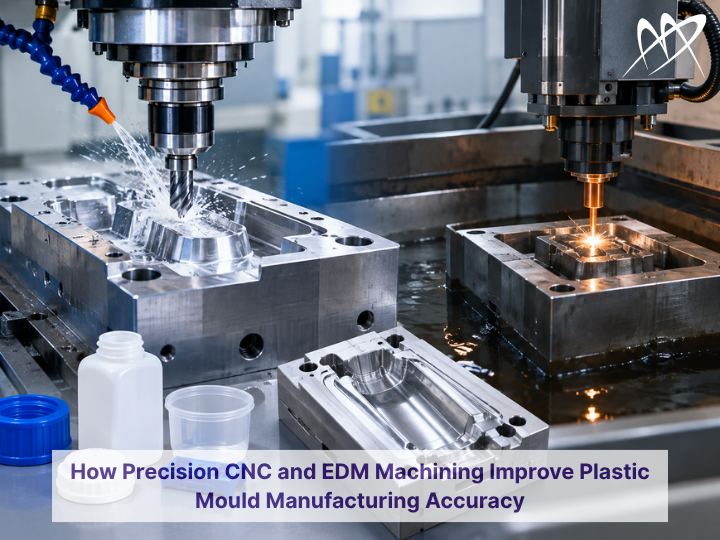
CNC and EDM machining are the processes that turn a mould design into physical steel and the accuracy of that process directly determines whether the finished mould matches the design intent or drifts from it. CNC machining handles the bulk of shaping, drilling, and contouring, while EDM machining is used for features that are too fine, too deep, or too geometrically complex for conventional cutting tools to reach.
Together, these two processes determine cavity precision, surface finish, and how consistently a mould's features are replicated across multiple cavities all of which affect part quality once the mould goes into production.
CNC Machining in Plastic Mould Manufacturing
CNC (Computer Numerical Control) machining uses computer-guided cutting tools to shape mould components cavities, cores, mould bases, and inserts to exact dimensional specifications. Because the process is computer-controlled rather than manually operated, it removes much of the variability that comes with manual machining, particularly across repeated features like multi-cavity blocks.
Why it matters: consistency across cavities is one of the biggest factors in multi-cavity mould performance. If eight cavities are cut with even slight variation between them, the mould will produce parts with different weights, wall thicknesses, or dimensions depending on which cavity they came from a problem that's difficult to fix after the mould is built.
Where it's useful: CNC machining handles the majority of a mould's geometry parting lines, cavity blocks, cooling channel drilling, and mould base components. It's particularly important for high-cavitation moulds, where any inconsistency is multiplied across every cavity and every cycle.
Use case: A manufacturer producing high-volume PET preforms across a 48-cavity mould depends on CNC precision to keep every cavity within the same tight tolerance band. A manufacturer building a lower-cavitation technical part with tighter dimensional callouts depends on the same CNC precision, but applied to fewer, more geometrically complex cavities.
EDM Machining: Handling What CNC Cannot
EDM (Electrical Discharge Machining) removes material using controlled electrical discharges rather than a physical cutting tool. This allows it to machine features that conventional CNC tooling can't reach deep, narrow slots, sharp internal corners, and hardened steel that would wear down a cutting tool quickly.
Why it matters: many mould features critical to part quality fine ribs, sharp corners, deep narrow channels near a gate or vent are geometrically impossible to cut with a rotating tool. EDM reaches these areas without the mechanical stress a cutting tool would introduce, which matters for maintaining dimensional accuracy in already-hardened steel.
Where it's useful: EDM is commonly used for gate inserts, fine detail work, textured surfaces, and hardened cavity features that need finishing after heat treatment. It's also used for correcting or refining features on a mould after initial CNC roughing, where a cutting tool alone can't achieve the required precision.
Use case: A cap or closure mould with fine thread detail on the core often relies on EDM to achieve sharp, accurate thread geometry that a CNC tool would struggle to replicate cleanly in hardened steel. A preform mould's gate area, where precise, small-radius geometry affects fill behavior, is another area where EDM finishing is common.
How CNC and EDM Work Together
In practice, CNC and EDM aren't competing methods they're complementary stages in the same manufacturing process. CNC typically handles the bulk material removal and overall shaping, while EDM finishes the features that require tighter tolerances, sharper geometry, or work on hardened steel that would be impractical to machine conventionally.
A mould built entirely on CNC without EDM finishing on critical features risks slightly rounded corners, less precise fine detail, and potential compromises on hardened-steel areas. A mould that relies too heavily on EDM without accurate CNC roughing risks longer machining times and higher costs without a proportional accuracy benefit. The right balance depends on the specific mould's geometry, material, and the tolerances required for its application.
What Accuracy in Machining Actually Affects Downstream
Machining precision isn't an abstract quality metric it shows up directly in how a mould performs once it's running.
Wall thickness consistency. Cavity and core machining accuracy directly determines wall thickness uniformity, which matters for structural integrity in technical parts and stretch behavior in PET preforms during blow moulding.
Parting line fit. Precisely machined parting line surfaces close cleanly under clamping pressure, reducing flash. Slightly inaccurate machining here is one of the most common causes of flash issues during trial and production.
Cooling efficiency. CNC-drilled or milled cooling channels need to be positioned accurately relative to the cavity surface. Misaligned channels reduce cooling efficiency unevenly across the part, which can affect cycle time and, for crystallization-sensitive materials, part clarity.
Cavity-to-cavity replication. In multi-cavity moulds, machining accuracy determines how identical each cavity actually is directly affecting whether a batch of parts is dimensionally consistent regardless of which cavity produced them.
Factors Buyers Should Consider When Evaluating Machining Quality
-
Tolerance range the manufacturer works to, and whether that tolerance is verified and documented, not just stated as a general capability.
-
Equipment used for both CNC and EDM, since machine age, calibration, and control system precision directly affect achievable accuracy.
-
How cavity-to-cavity consistency is measured in multi-cavity moulds, particularly for high-cavitation projects.
-
Experience with the specific material and geometry involved a manufacturer skilled at general injection tooling may have less depth in PET preform-specific machining requirements, or vice versa.
-
Post-machining inspection process, including how dimensional verification is documented before a mould moves to trial.
Common Mistakes When Evaluating Machining Capability
-
Assuming "CNC machining" alone signals precision, without asking about tolerance range, equipment calibration, or verification process.
-
Overlooking EDM capability entirely, which matters significantly for hardened steel finishing and fine detail work that CNC can't achieve alone.
-
Not asking how cavity-to-cavity consistency is checked in multi-cavity moulds, where machining variation has an outsized impact on production consistency.
-
Focusing on machining speed over accuracy, particularly for complex or high-cavitation moulds where rushed machining tends to show up as trial issues later.
-
Treating machining as a one-time step rather than an iterative process that includes CNC roughing, EDM finishing, and dimensional verification before the mould is considered complete issues missed here tend to surface later during mould trial and validation.
Where This Fits with Dowell Moulds
Machining accuracy is foundational to every category of mould Dowell Moulds manufactures from injection moulds and PET preform moulds to compression closures moulds and blow moulds. CNC and EDM precision at the machining stage is one of the reasons cavity consistency and cycle-time performance hold up once a mould reaches trial.
For buyers specifically comparing PET preform mould manufacturers, our article on what makes a high-quality PET preform mould breaks down cavity precision, steel selection, and cooling design in more depth. To review the specific machining equipment and processes involved, you can view our manufacturing capabilities directly.
Final Takeaway
Machining accuracy isn't a background detail in mould manufacturing it's one of the clearest drivers of whether a mould performs consistently once it reaches production. CNC and EDM machining serve different but complementary roles, and understanding how a manufacturer applies each one, and how consistency is verified across cavities, gives buyers a much clearer picture of mould quality than reviewing a design drawing alone.
If you're evaluating a mould project and want to understand the machining approach behind it, you can get in touch with our engineering team to discuss your specific tolerances and application requirements.