
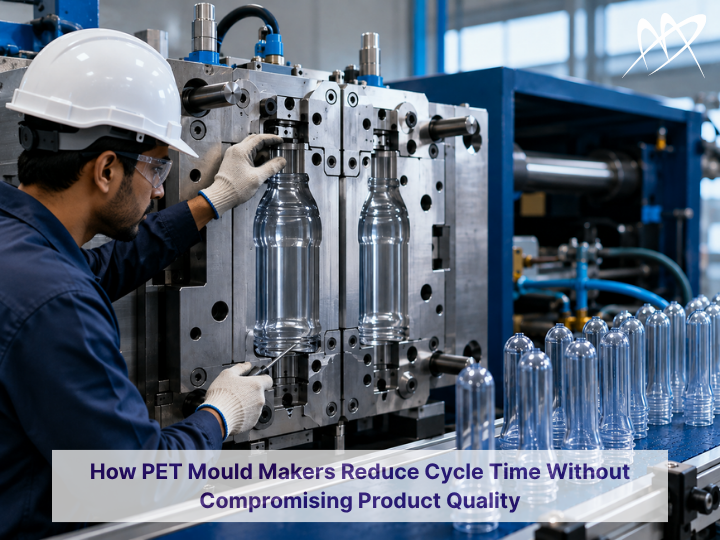
For PET preform manufacturers, reducing cycle time is one of the most effective ways to increase production capacity without adding another injection moulding machine. However, simply reducing cooling or injection time can create dimensional variation, deformation, inconsistent preform weight, and higher rejection rates.
Experienced PET Mould Makers take a different approach. Instead of treating cycle time as a machine-setting issue, they optimize the complete moulding system, including cooling, hot runner balance, cavity geometry, gate design, temperature control, ejection, and machine compatibility.
The real objective is not the shortest possible cycle. It is the shortest stable cycle that consistently produces conforming PET preforms.
Why Cycle Time Matters in PET Preform Manufacturing
A PET preform moulding cycle typically includes mould closing, injection, packing, cooling, mould opening, and ejection. Each stage contributes to overall production time, but cooling is often one of the most important areas for optimization because PET must reach sufficient rigidity before ejection.
For high-cavitation moulds, even a small reduction in stable cycle time can significantly increase output because multiple preforms are produced during every cycle.
However, cycle-time optimization should be evaluated alongside:
-
Preform weight consistency
-
Wall-thickness uniformity
-
Neck dimensions
-
Gate quality
-
Ejection condition
-
Cavity-to-cavity variation
-
Rejection rate
-
Mould temperature stability
This leads to a more practical production equation:
Lower cycle time + stable processing + consistent quality = genuine productivity improvement.
7 Ways PET Mould Makers Reduce Cycle Time
1. Optimizing Cooling for Faster Heat Removal
Cooling is central to PET preform mould performance because the mould must remove heat from the injected material efficiently before ejection.
Experienced PET Preform Mould Manufacturers design cooling circuits around the actual geometry of the core, cavity, and gate region rather than simply adding more cooling channels.
Important engineering considerations include:
-
Channel position relative to the moulding surface
-
Cooling-channel diameter
-
Coolant flow rate
-
Circuit length and balance
-
Core cooling efficiency
-
Cavity cooling
-
Temperature uniformity
-
Heat concentration around the gate
The core is particularly important in PET preform production because a substantial portion of the preform geometry surrounds it. Inefficient heat removal from this region can extend cooling requirements even when other areas of the mould are adequately cooled.
A well-designed cooling system helps remove heat more uniformly, allowing manufacturers to optimize cooling time without creating premature ejection problems.
2. Balancing Multi-Cavity Filling
High-cavity PET preform moulds are designed to maximize output per machine cycle. But increasing cavity count also makes flow balance increasingly important.
If cavities receive different melt-flow conditions, manufacturers may experience variation in:
-
Preform weight
-
Wall thickness
-
Neck finish
-
Gate appearance
-
Cooling behavior
-
Shrinkage
A properly engineered PET Preform Mould uses an appropriately balanced runner and hot runner arrangement so that cavities operate under comparable filling conditions.
Cavity balance is therefore not only a quality issue. It can also influence cycle optimization because unstable cavities may force operators to use more conservative processing parameters.
3. Improving Hot Runner and Gate Performance
The hot runner system controls how molten PET travels from the injection unit toward individual cavities. Its design can significantly influence filling consistency and process stability.
For a High-Speed PET Mould, the hot runner must support rapid and repeatable material delivery while maintaining suitable thermal conditions.
Engineers typically consider:
-
Runner balance
-
Nozzle design
-
Melt temperature stability
-
Thermal control
-
Pressure distribution
-
Gate geometry
-
Gate location
Gate design deserves particular attention because the gate is where material enters the preform cavity and where localized heat conditions can affect cooling and ejection.
A properly engineered gate can support consistent filling and predictable cooling while minimizing problems such as excessive gate vestige or localized thermal concentration.
4. Maintaining Uniform Mould Temperature
Fast production requires more than aggressive cooling. It requires controlled and repeatable thermal conditions.
PET processing is sensitive to temperature because changes in material temperature can influence viscosity, filling behavior, cooling, shrinkage, and final dimensions.
For this reason, PET mould makers consider temperature uniformity across cavities rather than focusing only on the average mould temperature.
Stable thermal conditions can help manufacturers:
-
Maintain consistent filling
-
Reduce cavity-to-cavity variation
-
Improve dimensional repeatability
-
Optimize cooling
-
Reduce process adjustments
The objective is controlled heat transfer, not simply maximum cooling.
5. Reducing Unnecessary Mould Movement
Not every cycle-time improvement comes from injection or cooling.
Mould closing, opening, ejection, and component movement also contribute to total cycle duration. Precision mould construction can help these operations occur smoothly and repeatably.
An efficient ejection system should remove preforms quickly while minimizing:
-
Sticking
-
Deformation
-
Misalignment
-
Unnecessary mechanical movement
-
Delays between mould opening and ejection
When the mould, ejection system, and automation are correctly coordinated, manufacturers can reduce non-productive time without compromising the preform.
6. Manufacturing Critical Components With High Precision
Cycle-time optimization begins during mould manufacturing.
Cavities, cores, inserts, gates, and other critical components must be produced within the required dimensional tolerances. Consistent machining supports repeatable mould performance across all cavities.
For a PET Bottle Preform Mould, particular attention is required around:
-
Neck finish geometry
-
Preform body
-
Gate area
-
Core and cavity alignment
-
Cavity matching
-
Ejection surfaces
Better component accuracy can reduce process adjustments during mould trials and help maintain consistent production after commissioning.
Precision also matters for maintenance. Components manufactured consistently are easier to inspect, replace, and maintain over the mould's production life.
7. Matching the Mould to the Injection Moulding Machine
A high-performance mould cannot deliver its full potential if it is poorly matched to the injection machine.
Before mould development, engineers should evaluate:
-
Injection capacity
-
Clamping force
-
Platen dimensions
-
Tie-bar spacing
-
Maximum mould height
-
Injection pressure
-
Machine control system
-
Cooling capacity
-
Automation requirements
This becomes increasingly important with high-cavity moulds because the machine must support the required injection volume, pressure, cooling infrastructure, and cycle speed.
A mould designed around the actual production machine is more likely to achieve stable performance than a mould designed independently of the manufacturing environment.
How Cycle-Time Reduction Can Affect PET Preform Quality
The biggest mistake in cycle-time optimization is assuming that every reduction is beneficial.
For example, reducing programmed cooling time without improving heat transfer can cause the preform to be ejected before it has sufficient structural stability.
Possible consequences include:
-
Preform deformation
-
Dimensional variation
-
Inconsistent shrinkage
-
Surface defects
-
Weight variation
-
Downstream bottle-quality problems
This is why experienced PET Mould Makers focus on removing inefficiencies rather than simply removing seconds from the cycle.
Improving cooling efficiency, cavity balance, gate performance, and thermal control can create a safer path toward shorter production cycles.
How Manufacturers Should Measure Cycle-Time Improvements
A shorter cycle should always be evaluated against product quality and production stability.
Manufacturers can monitor:
Total cycle time: Measures the complete moulding cycle.
Cooling time: Indicates how efficiently heat is being removed before ejection.
Preform weight variation: Helps identify cavity-to-cavity filling differences.
Dimensional consistency: Confirms that faster production is not affecting critical geometry.
Rejection rate: Shows whether cycle reduction is creating hidden quality costs.
Mould temperature stability: Helps identify thermal variation that may affect repeatability.
Downtime and maintenance frequency: Determines whether faster operation is sustainable over long production runs.
This approach gives manufacturers a better picture of whether a cycle-time reduction is producing genuine operational value.
Common Problems That Increase PET Mould Cycle Time
Cycle-time losses are not always caused by the original mould design. Maintenance and operating conditions can also gradually reduce performance.
Blocked Cooling Channels
Deposits or contamination inside cooling circuits can restrict coolant flow and reduce heat-transfer efficiency.
Unbalanced Cavities
Flow or thermal imbalance can force operators to use conservative settings to maintain acceptable preform quality.
Temperature Fluctuations
Unstable mould or melt temperatures can make the process less predictable and increase the need for adjustments.
Worn Mould Components
Wear around gates, cores, cavities, alignment components, or ejection systems can gradually affect production stability.
Poor Preventive Maintenance
A mould that is not regularly inspected and maintained may require longer cycles to compensate for declining performance.
These issues show why cycle-time optimization should be considered a mould lifecycle strategy, not only a commissioning exercise.
What Should Buyers Look for in PET Mould Makers?
When purchasing a PET mould, buyers should look beyond the quoted price and advertised cycle time.
A capable PET Injection Mould Supplier should demonstrate expertise in both mould engineering and production requirements.
Consider the following:
PET Moulding Experience
Does the manufacturer understand PET preform geometry, high-cavity moulds, cooling, hot runners, gates, and thermal management?
Engineering Capability
Can the supplier develop the mould around the required preform design, cavity count, machine, and production target?
Precision Manufacturing
Does the manufacturer have the machining and inspection capability required for consistent cavity and core production?
Testing and Validation
Are mould trials performed to evaluate filling, cooling, ejection, dimensions, weight, and cavity consistency?
Maintenance Support
Can the supplier support troubleshooting, spare components, preventive maintenance, and future mould modifications?
Long-Term Reliability
Can the mould maintain stable performance over extended production rather than only achieving a good initial trial?
These factors are often more important to total production cost than the initial mould purchase price.
Why Experienced PET Preform Mould Manufacturers Matter
PET preform production is a high-volume application where small process differences can become significant over millions of cycles.
Experienced PET Preform Mould Manufacturers understand that mould performance must be evaluated across the entire production system.
A well-engineered mould should combine:
-
Efficient cooling
-
Balanced cavity filling
-
Stable hot runner performance
-
Controlled gate geometry
-
Precision cavity and core machining
-
Reliable ejection
-
Machine compatibility
-
Practical maintenance access
This combination helps manufacturers pursue higher output while maintaining consistent preform quality.
Why Choose Dowell Moulds for PET Moulding Applications?
For manufacturers evaluating a PET mould supplier, the most valuable capability is the ability to connect mould design decisions with real production requirements.
Dowell Moulds focuses on precision mould manufacturing and application-oriented engineering for demanding plastic processing requirements.
When developing a PET mould, important considerations include cavity configuration, preform geometry, cooling design, hot runner performance, machining accuracy, mould maintenance, and compatibility with the customer's injection moulding equipment.
Rather than evaluating a mould only by its initial trial cycle, manufacturers should consider its long-term production value including cycle stability, preform consistency, maintenance requirements, mould life, and technical support.
This approach provides a more reliable basis for selecting a PET mould manufacturing partner.
Final Thoughts
Reducing PET preform mould cycle time without compromising quality requires more than changing machine settings.
Cooling-channel design, cavity balance, hot runner performance, gate geometry, temperature control, precision manufacturing, ejection, maintenance, and machine compatibility all contribute to the final production cycle.
The goal for modern PET Mould Makers is therefore not simply to create the fastest possible mould. It is to develop a mould capable of maintaining a fast, stable, repeatable, and quality-controlled production cycle.
For high-volume manufacturers, this can translate into better machine utilization, higher output, lower process variation, and more predictable production costs.
When selecting PET Preform Mould Manufacturers or a PET Injection Mould Supplier, buyers should look beyond the initial mould price and advertised cycle time. The stronger purchasing decision considers the complete combination of speed, precision, quality, reliability, maintainability, and mould life.