
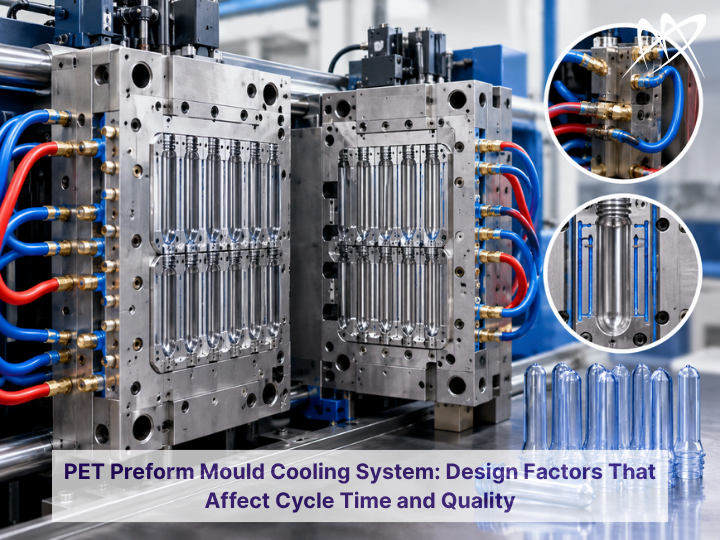
Cycle time gets most of the attention in PET preform injection moulding discussions, usually framed as a machine speed or process setting issue. In practice, a large share of achievable cycle time is decided long before the machine starts running at the point where the mould's cooling system was designed. A poorly laid out cooling circuit doesn't just slow production down. It can also show up as clarity issues, uneven wall crystallization, and dimensional inconsistency that only becomes obvious once preforms reach the blow-moulding stage.
Cooling is often treated as a secondary consideration in PET preform mould design, ranked behind cavity design, steel selection, or hot runner balancing. For PET preforms specifically, it deserves equal attention, because PET's crystallization behavior makes it far more sensitive to cooling rate and uniformity than many other resins used in packaging production.
What a PET Preform Mould Cooling System Actually Does
A PET preform mould cooling system removes heat from the molten PET as it fills and solidifies inside the cavity. The goal is to extract that heat quickly enough to support a fast cycle, while doing so evenly enough that the preform cools at a consistent rate across its entire wall structure.
This second part matters more for PET than it does for many other plastics. PET is a semi-crystalline resin, and its clarity depends on controlling crystallization during cooling. Cooling that's too slow, or uneven across different areas of the preform, allows localized crystallization that shows up as haziness or inconsistent optical clarity a defect that can't be corrected later in the blow-moulding process. How well a cooling system handles this is one of the clearer ways to tell a strong PET preform mould manufacturer apart from one that's simply replicating a generic cooling template across different projects.
Why Cooling Design Carries More Weight in PET Preform Injection Moulding
Most injection moulded plastic parts tolerate some variation in cooling rate without a major quality consequence. PET preforms are less forgiving, for a few specific reasons:
-
Clarity requirements. Many PET preform applications beverage bottles especially require consistent optical clarity, which depends directly on controlled, even cooling that limits unwanted crystallization.
-
Wall thickness sensitivity. Preform wall thickness directly affects how the material stretches during blow moulding. Uneven cooling across the wall creates inconsistent material properties that translate into uneven stretch ratios downstream.
-
High cavitation production. PET preform moulds commonly run with high cavity counts, which means any cooling inconsistency between cavities gets magnified across an entire production batch rather than affecting a single part.
-
Cycle time economics. Because PET preform production typically runs at high volume, even small inefficiencies in cooling design compound into significant cycle time losses over a full production run.
Core PET Preform Mould Design Factors That Determine Cooling Performance
Channel proximity to the cavity surface: Cooling channels positioned closer to the cavity wall extract heat more directly and consistently than channels placed farther away for manufacturing convenience. The tradeoff is structural channels placed too close to thin-walled sections of the mould can compromise strength, so this requires balancing cooling efficiency against mould durability. This balance is typically most difficult around the preform's base and gate area, where wall sections tend to be thicker and heat extraction naturally takes longer, making those zones a common source of cycle time bottlenecks if cooling isn't specifically designed around them.
Channel layout and coverage: Straight-drilled cooling channels are simpler and less expensive to machine, but they don't always follow the preform's geometry closely enough to cool every section evenly. Conformal cooling channels, designed to follow the contour of the cavity more closely, generally support more even heat extraction, particularly around complex geometry like the neck finish or base.
Coolant flow rate and turbulence: Heat transfer efficiency depends on how the coolant moves through the channel, not just where the channel is positioned. Laminar flow, where coolant moves smoothly with minimal mixing, transfers heat less efficiently than turbulent flow, where the coolant mixes actively against the channel walls. Channel diameter and flow rate both affect whether the flow achieves the turbulence needed for efficient cooling.
Cavity-to-cavity cooling balance: In multi-cavity PET preform moulds, every cavity needs a cooling circuit that performs equivalently to the others. A cooling circuit that favors cavities closer to the coolant inlet, while under-cooling cavities farther along the circuit, creates batch-to-batch inconsistency even when each individual cavity is otherwise well designed. This is one of the first things worth asking a PET preform mould supplier about directly, since it's rarely visible on a spec sheet but has an outsized effect on production consistency.
Coolant temperature control: Consistent inlet temperature across the production run matters as much as channel design itself. Coolant that warms up progressively during a long production run, without adequate temperature regulation, gradually reduces cooling efficiency over time, even though the mould's physical design hasn't changed.
How Cooling Design Affects Cycle Time
Cooling typically accounts for the largest portion of total cycle time in PET preform injection moulding, more than injection or packing phases combined. A cooling system that removes heat efficiently shortens this phase directly, which is why cooling design has an outsized effect on overall production throughput compared to most other mould design decisions.
The relationship isn't simply "faster cooling is always better," though. Cooling that's too aggressive or uneven can lock in residual stress or create cosmetic issues even while technically completing faster. The practical goal is the fastest cooling that still produces a preform within quality specification not the fastest cooling a system is mechanically capable of achieving.
For manufacturers running high-volume production, even a fraction of a second saved per cycle compounds significantly across a full day of continuous operation. This is part of why cooling system design deserves the same upfront engineering attention as cavity geometry a mould that saves time on every single shot has a much larger cumulative impact on output than almost any other single design decision.
How Cooling Design Affects Preform Quality
Cooling influences PET preform quality across several dimensions beyond basic clarity:
-
Dimensional stability. Uneven cooling causes uneven shrinkage, which affects wall thickness consistency and overall dimensional accuracy.
-
Crystallinity distribution. Inconsistent cooling rates across the preform wall create varying crystallinity levels, which later affects how the material stretches and performs during blow moulding.
-
Internal stress. Cooling too quickly in some areas while others cool more slowly can introduce internal stress that shows up later as warping or stress-cracking in the finished bottle.
-
Surface finish. Localized cooling inconsistency can create visible surface defects, particularly around the gate area or neck finish, where geometry is already more complex to cool evenly.
Common Mistakes in PET Preform Mould Cooling Design
-
Treating cooling channel layout as a standard, one-size-fits-all feature, rather than designing it specifically around the preform's wall thickness and geometry.
-
Prioritizing machining simplicity over cooling performance, choosing straight-drilled channels purely because they're cheaper to produce, even where conformal cooling would meaningfully improve consistency.
-
Overlooking cavity-to-cavity cooling balance in multi-cavity moulds, focusing cooling validation on a single representative cavity rather than confirming performance across the full cavity set.
-
Underestimating coolant temperature control, particularly for long, continuous production runs where gradual coolant warming can quietly reduce cooling efficiency over time.
-
Evaluating cooling performance only during a short trial run, missing how the system performs once it reaches thermal steady-state during sustained production.
Where Cooling Design Connects to Broader Mould Quality
Cooling system design doesn't function in isolation it connects directly to other aspects of PET preform mould design and manufacturing quality. Cooling channels are shaped and positioned through the same precision CNC and EDM machining processes that determine overall cavity accuracy, so machining quality directly limits how precisely a cooling layout can actually be executed.
Cooling performance is also something that should be confirmed during mould trial and validation, using a realistic production-length run rather than a short initial test, since cooling behavior often shifts once a mould reaches steady-state operating temperature. And because cooling affects dimensional consistency, it ties directly into how a mould holds the tolerance it was originally specified to meet.
Where This Fits with Dowell Moulds
Cooling system design is built into every PET preform mould Dowell Moulds manufactures, developed around the specific wall thickness, geometry, and cavitation requirements of each project rather than applied as a generic template. Manufacturers who want a closer look at how this is approached in practice can review our manufacturing capabilities or speak directly with our engineering team about cooling design for a specific application.
Final Takeaway
A PET preform mould cooling system shapes both how fast a mould can run and how consistently it produces parts within specification two outcomes that are easy to treat as separate concerns but are, in practice, the same engineering problem. Channel layout, flow dynamics, cavity-to-cavity balance, and coolant temperature control all influence cycle time and quality together, which makes cooling design worth the same level of attention typically given to cavity precision or steel selection, rather than treating it as a secondary detail finalized late in the design process.