
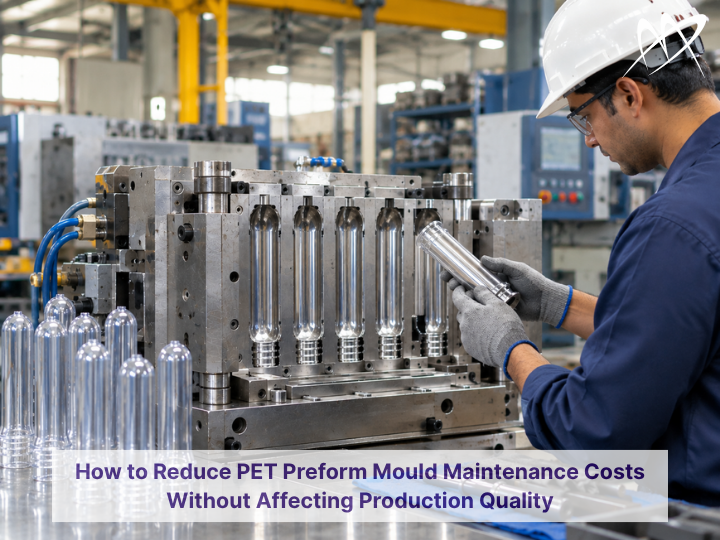
Maintenance costs on a PET preform mould tend to get treated as a fixed, unavoidable expense something that simply comes with running a mould over years of production. In practice, a meaningful portion of that cost is influenced by decisions made long before the mould ever needed a repair: the steel it was built from, how it was machined, how consistently it's inspected, and how quickly replacement parts can be sourced when something wears out.
Reducing PET preform mould maintenance cost isn't about cutting corners on upkeep. Skipping maintenance to save money usually costs more later, once a worn component starts affecting part quality or causes unplanned downtime. The more useful goal is reducing unnecessary maintenance spend while keeping the plastic mould maintenance practices that actually protect production quality intact.
This applies whether a manufacturer is working with a single PET mould supplier on an ongoing project or managing a mix of tooling from different sources. This article looks at what actually drives PET preform mould cost over a mould's working life, where maintenance spending is justified, and where it can genuinely be reduced without putting production output at risk.
Key Ways to Reduce PET Preform Mould Maintenance Costs
-
Select mould steel and heat treatment according to production volume and expected service life.
-
Schedule preventive maintenance using actual cycle counts rather than calendar intervals alone.
-
Monitor high-wear components such as ejector pins, gate inserts, and neck ring components.
-
Keep critical mould spare parts available to reduce unplanned downtime.
-
Track recurring component failures to identify underlying design or process issues.
-
Use precision CNC and EDM machining to reduce uneven wear and maintain dimensional accuracy.
-
Validate mould performance before full-scale production to identify potential problems early.
-
Match the hot runner system to the mould and production requirements.
What Drives PET Preform Mould Maintenance Costs
PET preform mould maintenance costs generally come from three sources, and each one responds to a different cost-reduction strategy:
-
Routine wear on high-friction components like ejector pins, gate inserts, and neck ring inserts, which experience repeated mechanical stress with every cycle. This kind of wear is predictable and, to some extent, manageable through material selection and preventive scheduling.
-
Corrective repairs that happen when something fails unexpectedly a cracked insert, a misaligned cooling channel, a hot runner issue often because an early warning sign wasn't caught during routine inspection. These repairs tend to cost significantly more than planned maintenance, both in parts and in the production time lost while the mould is down.
-
Downtime cost, which is often larger than the repair cost itself. A mould offline for two days during a scheduled maintenance window is a planned cost. The same mould offline for two days due to an unexpected failure, in the middle of a production commitment, carries the added cost of missed output and potential delivery delays.
Understanding which of these three categories is driving PET mould maintenance spend on a specific project is usually the first step toward reducing it. A manufacturer spending heavily on corrective repairs has a different problem, and a different fix, than one spending heavily on routine wear parts that are simply due for scheduled replacement.
|
Factor |
How It Affects Cost |
Cost-Reduction Approach |
|
Mould steel |
Influences wear resistance and service life |
Match steel to production requirements |
|
Heat treatment |
Affects component durability |
Use appropriate hardening specifications |
|
Machining accuracy |
Can influence alignment and uneven wear |
Use precision CNC and EDM machining |
|
Production cycles |
Higher cycles increase component wear |
Track actual cycle counts |
|
Hot runner system |
Affects heater and thermocouple servicing |
Use a properly matched system |
|
Spare parts |
Long lead times can increase downtime |
Keep critical wear parts available |
|
Maintenance records |
Poor records make planning difficult |
Maintain detailed service history |
Where Reducing Maintenance Spend Makes Sense
Cost reduction works best when it targets inefficiency, not necessity. Skipping scheduled inspections to save short-term cost typically shifts spending into the more expensive corrective-repair category later. Reducing maintenance cost in a way that actually holds up over time usually comes down to a few specific areas.
Preventive maintenance scheduling based on actual cycle counts, rather than a fixed calendar interval, tends to catch wear before it becomes a functional problem. A mould running at high cavitation and high cycle speed reaches the same wear threshold much faster than a lower-volume mould, so a maintenance schedule based purely on elapsed time can either intervene too early, at unnecessary cost, or too late, after damage has already occurred.
Spare parts planning reduces the cost of downtime rather than the cost of the repair itself. Having commonly worn components ejector pins, gate inserts, seals available before they're needed avoids the cost of expedited shipping or an idle mould waiting on parts.
Root cause tracking on repeated repairs identifies whether an issue is a one-off event or a symptom of an underlying design or material limitation. A gate insert that needs repeated replacement well ahead of its expected service life is often a sign of an upstream issue gate design, steel specification, or process settings rather than something to keep repairing indefinitely without investigating why it keeps happening.
Component and Material Choices That Reduce Long-Term Maintenance Need
The mould's original build has a direct effect on how much maintenance it will require over its working life.
Steel selection and hardening determine how long a mould holds its dimensional precision under repeated cycling. A mould built with steel and heat treatment matched to its actual production volume experiences slower wear at high-friction points than one built to a lower specification and then run at higher volume than originally planned.
Machining accuracy affects wear indirectly but significantly. A mould with precisely aligned parting lines and evenly machined cavities distributes clamping and injection forces more evenly, reducing localized wear compared to a mould with minor machining inconsistencies that concentrate stress in specific areas. This is one reason precision CNC and EDM machining at the build stage has a measurable effect on long-term maintenance frequency, not just initial part quality.
Hot runner system quality affects how often thermocouples, heaters, and flow components need servicing. A well-balanced, properly specified hot runner system generally requires less frequent intervention than one that was undersized or poorly matched to the specific PET preform mould it was built for. Heater bands and thermocouples that run consistently within their rated range tend to last considerably longer than components pushed past their intended operating conditions to compensate for an undersized system.
Working With a Spare Parts and Support Strategy
Maintenance cost isn't only about the parts themselves it's also about how quickly a mould gets back into production once a part needs replacing. Standardizing on components that are readily available, rather than highly custom parts with long lead times, reduces both the cost and the downtime associated with replacement.
This is where a manufacturer's ongoing spare parts supply matters as much as the original mould build. Manufacturers should discuss spare parts availability and lead time with their PET mould manufacturer as part of the original specification, not as an afterthought once something fails. For businesses running equipment changes or extending a mould's working life beyond its original production plan, access to conversion kits matters just as much confirming this support upfront, rather than assuming it will be available on short notice later, avoids a common source of unplanned downtime cost.
Common Mistakes That Increase Maintenance Costs Over Time
Several recurring practices tend to drive maintenance spend higher than necessary, often without being obvious at the time:
-
Deferring minor repairs until a scheduled shutdown, when the issue is already affecting part quality, allows a small problem to continue producing marginal or rejected parts in the meantime.
-
Treating every repair as an isolated event, rather than tracking patterns across repeated failures, misses opportunities to fix an underlying cause instead of repeatedly replacing the same worn component.
-
Under-specifying steel or hardening to reduce upfront mould cost often increases long-term maintenance spend once the mould is running at full production volume.
-
Skipping documentation of maintenance history, which makes it harder to plan future service intervals accurately, since there's no reliable record of how components have actually worn over time.
How Trial and Design Decisions Connect to Long-Term Maintenance
Maintenance requirements aren't only determined after a mould enters production many of them are set during the original design and validation process. A mould validated properly during mould trial and validation is less likely to reveal design-related wear issues only after it's already running in full production, since problems like uneven cavity loading or narrow process windows tend to surface at the trial stage if they're checked for properly.
Tolerance specification plays a role as well. A mould built to unnecessarily tight mould tolerance on non-critical dimensions can be more sensitive to minor wear, requiring more frequent adjustment to stay within spec than a mould where tolerance was matched appropriately to each dimension's actual functional requirement.
Where This Fits with Dowell Moulds
Reducing PET preform mould maintenance cost starts with decisions made at the manufacturing stage steel specification, machining precision, and hot runner design all affect how much upkeep a mould will need over its working life. Dowell Moulds builds this thinking into every mould it manufactures, alongside long-term production support for the manufacturers who rely on it.
Manufacturers evaluating a PET preform mould manufacturer partly on long-term maintenance cost can review our manufacturing capabilities or contact our engineering team to discuss maintenance planning for a specific production volume and application.
Final Takeaway
Reducing PET preform mould maintenance cost without affecting production quality comes down to targeting the right kind of savings cutting unnecessary or poorly planned spend, not the maintenance that actually protects part quality and prevents costly downtime. Steel selection, machining precision, spare parts planning, and proper trial validation all influence how much a mould will cost to maintain over its working life, which makes these decisions worth evaluating early rather than only after maintenance costs start climbing