
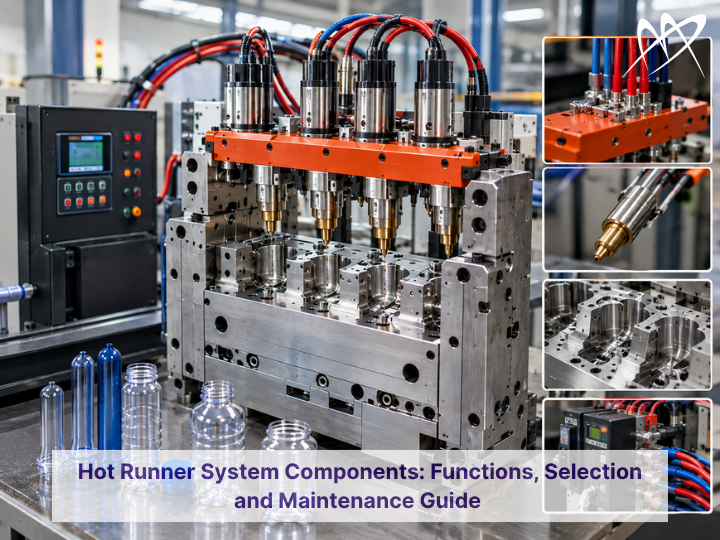
A hot runner mould is an injection moulding system that keeps molten plastic at a controlled temperature as it flows from the injection unit to the mould cavities. Its main components include the manifold, nozzles, heaters, thermocouples, temperature controller, and thermal insulation. Each component plays a specific role in maintaining resin temperature, controlling material flow, and achieving consistent cavity filling.
Understanding the functions of hot runner mould components helps manufacturers evaluate mould specifications, troubleshoot production issues, and make informed decisions when selecting a hot runner mould manufacturer or supplier. This guide explains the main components, their functions, system selection factors, and essential maintenance practices.
Key Hot Runner Mould Components at a Glance
A hot runner mould typically consists of a manifold, nozzles, heaters, thermocouples, temperature controllers, and thermal insulation. Each component has a specific role in maintaining resin temperature, controlling flow, and achieving consistent filling across cavities. The correct configuration depends on factors such as resin type, cavitation, gate requirements, production volume, and maintenance needs.
What a Hot Runner System Does
A hot runner system keeps molten plastic at a controlled temperature as it travels from the injection unit to each cavity, eliminating the solidified runner waste that a cold runner system produces. This matters for both material efficiency and cycle time, since there's no runner to cool, eject, and regrind on every cycle.
For multi-cavity moulds especially, a hot runner system also plays a direct role in part consistency. If resin doesn't reach every cavity at the same temperature and pressure, cavities fill unevenly, producing parts with different weights, dimensions, or cosmetic quality depending on which cavity they came from. Each of the hot runner mould components covered below contributes to that consistency in a different way, which is why evaluating them individually matters more than judging a system as a single unit.
Core Hot Runner Mould Components
Manifold: Naturally balanced manifold layouts use geometrically comparable flow paths to support consistent cavity filling. However, manifold performance also depends on channel dimensions, resin properties, processing conditions, and the overall mould design. Engineered flow balancing may also be used when the application requires it.
Nozzles: Nozzles sit at the end of each manifold drop and deliver resin directly into the cavity or sub-runner. Nozzle type affects gate quality, gate vestige size, and how cleanly the part separates from the gate after injection. Valve-gated nozzles use a mechanical pin to control flow timing precisely, which is useful for sequential filling or minimizing gate marks on cosmetically visible parts. Open or thermal-gated nozzles are simpler and generally lower-cost, suited to applications where gate vestige isn't a critical concern.
Heaters: Heater placement and wattage should match the thermal requirements of the manifold or nozzle. Incorrect heater sizing, placement, or temperature control can cause uneven heating, temperature fluctuations, or localized overheating, potentially affecting resin quality and moulding consistency.
Thermocouples: Thermocouples monitor actual temperature at key points throughout the hot runner system and feed that data back to the temperature controller. Accurate thermocouple placement, close to the actual heat source rather than at a convenient but less representative location, has a direct effect on how precisely the system can regulate temperature.
Temperature controller: The controller reads thermocouple data and adjusts heater output to maintain target temperatures across every zone of the hot runner system. A controller with more independent zones allows finer temperature tuning across a multi-cavity mould, which becomes increasingly important as cavitation and manifold complexity increase.
Manifold and nozzle insulation: Insulating plates and air gaps reduce heat transfer from the hot runner system into the surrounding mould base, protecting temperature-sensitive components and preventing unwanted heat loss that would force heaters to work harder than necessary.
|
Component |
Main Function |
Key Consideration |
|
Manifold |
Distributes molten resin to multiple cavities |
Flow balance |
|
Nozzle |
Delivers resin into the cavity |
Gate quality and vestige |
|
Heater |
Maintains required resin temperature |
Correct wattage and placement |
|
Thermocouple |
Measures temperature |
Accurate positioning |
|
Temperature Controller |
Regulates individual heating zones |
Zone control |
|
Insulation |
Reduces unwanted heat transfer |
Thermal efficiency |
What to Consider When Selecting a Hot Runner System
Cavitation and flow balance requirements: Higher cavitation counts place more demand on manifold design and flow balancing, so a hot runner system suited to a 4-cavity mould often needs a fundamentally different manifold layout than one suited to a 48-cavity application, not just a scaled-up version of the same design.
Resin sensitivity: Some resins are more sensitive to thermal degradation, shear stress, and residence time than others. PET, for example, requires appropriate resin drying and careful control of melt temperature and residence time. Processing conditions can influence acetaldehyde formation and preform clarity. These requirements should be considered when selecting a hot runner PET preform mould and its temperature-control configuration.
Gate quality requirements: Applications where gate vestige or cosmetic appearance matters caps and closures in particular often justify the added cost of valve-gated nozzles. Less visually critical parts may perform adequately with simpler, lower-cost nozzle types.
Zone control granularity: Projects with complex cavity layouts or significant thermal variation across the mould benefit from controllers offering more independent temperature zones, even though this adds cost compared to a simpler, fewer-zone setup.
Serviceability: How easily individual components can be accessed, inspected, and replaced affects long-term maintenance cost and downtime. A system designed with service access as a consideration from the start tends to be faster and less disruptive to maintain than one where every repair requires significant disassembly. This is worth asking about directly during specification, since serviceability is rarely obvious from a drawing but has a measurable effect on how much production time is lost during routine upkeep.
Maintenance Requirements for Hot Runner System Components
Hot runner systems require more structured, ongoing maintenance than cold runner tooling, largely because they involve active heating elements and electronic controls rather than purely mechanical components.
-
Heater and thermocouple inspection - Heater bands degrade gradually and thermocouples can drift out of calibration over time, both of which reduce temperature control accuracy before failing outright. Periodic resistance checks on heaters and calibration checks on thermocouples catch this drift before it affects part quality.
-
Nozzle tip and gate inspection - Nozzle tips wear from repeated contact with abrasive or filled resins, which can affect gate quality and vestige size over time. Regular inspection catches wear before it becomes visible as a part defect.
-
Wiring and connector checks - Hot runner systems involve a significant amount of wiring routed through a thermally demanding environment. Loose connections or insulation degradation are a common, preventable cause of unplanned downtime.
-
Manifold cleaning during colour or resin changes - Residual material left in manifold channels during a changeover can contaminate the next production run, particularly with light-colored or optically clear resins.
-
Controller calibration verification - Periodically confirming that controller readings match actual measured temperature, rather than assuming the displayed value is accurate, catches sensor drift that would otherwise go unnoticed.
Common Mistakes With Hot Runner Systems
-
Treating all cavities as uniform during troubleshooting, rather than checking individual cavity performance when inconsistency shows up across a batch.
-
Delaying thermocouple calibration checks, allowing gradual drift to affect part quality before the issue becomes obvious enough to investigate.
-
Selecting nozzle type based on cost alone, without considering whether gate vestige or cosmetic requirements actually justify a different nozzle configuration.
-
Underspecifying zone control on complex, high-cavitation moulds, resulting in temperature inconsistency that a simpler controller configuration can't resolve.
-
Skipping manifold cleaning during resin or colour changeovers, leading to contamination issues that are harder to trace back to their actual cause.
How Hot Runner Design Connects to Overall Mould Performance
Hot runner system performance doesn't operate independently of the rest of the mould. Flow balance from the manifold directly affects how evenly the cooling system can manage heat across cavities, since cavities receiving resin at inconsistent temperatures also cool inconsistently. The precision of the manifold and nozzle machining itself depends on the same CNC and EDM processes used elsewhere in the mould, which is why hot runner accuracy and overall mould machining quality tend to track together. And because hot runner balance affects cavity-to-cavity consistency, it should be specifically evaluated during mould trial and validation, not assumed to be correct simply because the system was ordered to a particular cavitation count.
Where This Fits with Dowell Moulds
Dowell Moulds designs and manufactures hot runner mould systems across multiple applications, including hot runner cap moulds and hot runner closures moulds, each engineered around the specific resin, cavitation, and gate quality requirements of the project rather than built from a single standard template. For manufacturers comparing a hot runner system manufacturer on component quality and long-term serviceability, reviewing our manufacturing capabilities or speaking with our engineering team is a practical next step.
Final Takeaway
A hot runner system performs as well as its individual components are selected, machined, and maintained the manifold, nozzles, heaters, thermocouples, and controller all need to work together consistently rather than being evaluated separately. Understanding what each component actually does makes it easier to select the right hot runner mould specification for a given application and to catch maintenance issues before they affect part quality or production uptime.